
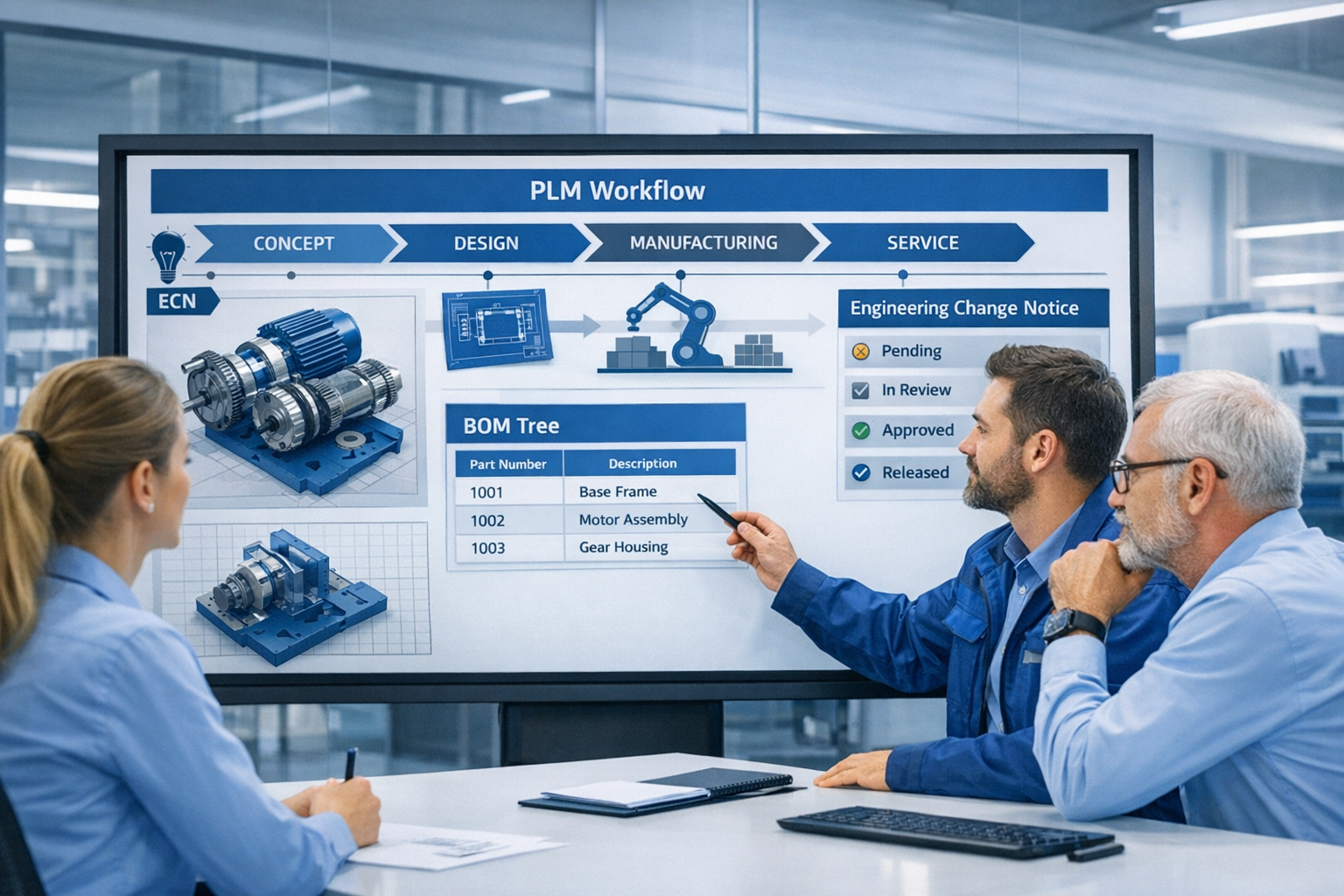
PLM in manufacturing stands for Product Lifecycle Management: software and process discipline that manages every piece of information about a product, from initial concept and CAD design, through bill of materials, engineering change control and production, to service and end-of-life. For UK manufacturers, PLM in manufacturing is the system of record for what a product is, how it changes over time and what evidence exists to prove it was built correctly.
Last updated: 16 May 2026
What is PLM in manufacturing and what does it cover?
PLM, short for Product Lifecycle Management, is a strategic approach and a class of enterprise software that manages the entire life of a manufactured product. According to SAP’s definition of PLM, the discipline connects every stage of a product’s lifetime, from initial design and engineering through manufacturing, service and retirement, using a common record of product data such as parts, materials, engineering changes, workflows and regulatory requirements.
In practice, PLM in manufacturing typically manages CAD files and drawings, engineering and manufacturing bills of materials, engineering change notices (ECNs) and engineering change orders (ECOs), product specifications, work instructions, technical files, compliance evidence, supplier and component data, and the workflows that move all of this through approval, release and revision control.
Where ERP answers “what should we make, buy and ship this week?”, and MES answers “what is happening on the shop floor right now?”, PLM answers “what exactly is this product, in this revision, and how do we change it safely?”. It is the product’s single source of truth.
Why PLM in manufacturing matters for UK CEOs and MDs
For UK manufacturing boards, PLM is less about engineering tooling and more about commercial control. The most common reasons UK manufacturers invest in PLM are:
- One controlled BOM. A single, version-controlled bill of materials that engineering, purchasing, production and quality all work from, eliminating rekeyed and out-of-date spreadsheets.
- Fast, auditable engineering change. ECNs and ECOs that move through review, approval and release in days, not weeks, with a complete electronic audit trail for customers and regulators.
- Right-first-time production. The shop floor always builds to the latest released revision, not last quarter’s printed drawing.
- Customer and regulatory compliance. Documented design controls for AS9100, ISO 13485, IATF 16949, DEF STAN, MHRA GxP and customer-specific quality requirements.
- Cleaner cost and margin data. Standard costs, supplier costs and should-cost analysis tied to specific BOM revisions, so finance and sales can quote and report with confidence.
- Protected intellectual property. Role-based access, versioning and audit logs that protect designs, recipes and process know-how from accidental loss or unauthorised use.
- Faster new product introduction. Structured stage-gates, parallel engineering and supplier collaboration that shorten time-to-market.
According to Made Smarter, UK manufacturers adopting connected digital technologies, including PLM and the digital thread, typically see measurable productivity gains, faster NPI cycles and reduced waste. PLM is squarely within the scope of Made Smarter Adoption co-funding for eligible SME manufacturers.
How PLM in manufacturing works in practice
A typical PLM system sits at the centre of an engineering and manufacturing data flow. Designers and engineers create parts and assemblies in CAD (SolidWorks, Inventor, Creo, NX, Fusion, CATIA). PLM captures and version-controls those files, links them to part numbers, builds an engineering BOM, and routes new parts and revisions through electronic approval workflows.
Once a design is released, PLM transforms the engineering BOM into a manufacturing BOM and pushes it to ERP, where it drives MRP, purchasing, costing and planning. From ERP, work orders flow into MES on the shop floor. When the design changes, the ECN process in PLM updates the BOM, the drawings, the work instructions and, where appropriate, the quality plan, and pushes the changes back into ERP and MES so the next build uses the new revision.
Around this core, PLM holds quality records (FMEAs, control plans, PPAP packs, IQ/OQ/PQ documents), supplier and component data, compliance evidence (REACH, RoHS, conflict minerals, UKCA, CE, MHRA technical files), and increasingly service and field data captured from connected products. Joined-up, this is what vendors and analysts call the “digital thread”.
PLM vs ERP, MES, PDM and CAD
One of the most common questions UK manufacturing boards ask is how PLM sits alongside the other systems. A simple way to think about it:
- CAD creates the geometry and engineering drawings.
- PDM manages and version-controls those CAD files and engineering data.
- PLM extends PDM across the full lifecycle: BOMs, ECNs, workflows, compliance, supplier data, integration with ERP and MES.
- ERP runs the commercial business: orders, finance, planning, stock, purchasing.
- MES runs shop-floor execution: work orders, machines, operators, OEE, traceability.
- QMS / eQMS manages non-conformance, CAPA, audits, training and document control.
In a mature digital factory, PLM defines the product, ERP commits to making and selling it, MES executes it on the line, and QMS proves it was built and inspected correctly. PLM is the upstream foundation that the others depend on.
What to look for when choosing a PLM system
PLM is a multi-year, multi-department commitment, with project costs typically running from £50,000 to £500,000+ depending on scope, number of users and integration depth. A few things to check before you commit:
- Fit for your sector. Aerospace, medical device, automotive, electronics, food and drink, and discrete fabrication have very different PLM patterns. Insist on reference customers in your sector and size band.
- CAD integration. Strong, supported connectors for the CAD platforms you actually use, not just slideware.
- ERP integration. A clean, well-documented integration with your ERP (SAP, Microsoft Dynamics 365, IFS, Epicor, NetSuite, Infor, Sage, Oracle) so BOMs and ECNs flow without rekeying.
- Configurable workflows. Approval routes, ECN templates and stage-gates that you can configure as your process evolves, without paying the vendor for every change.
- Cloud or on-premise. A clear, honest answer on hosting, data residency in the UK or EEA, and SLAs. The ICO’s UK GDPR guidance still applies to engineering data that contains personal information (e.g. design authority sign-offs).
- Security and IP protection. Role-based access, audit logs, encryption at rest and in transit, and alignment to Cyber Essentials and ISO 27001 expectations.
- Total cost of ownership. Licences, infrastructure, integration, training, support and internal time. Three- and five-year TCO matter more than first-year cost.
- Realistic timeline. A first PLM rollout typically takes 6 to 18 months. Anyone promising 8 weeks for a serious multi-CAD, multi-ERP deployment is selling slideware.
Where Made Smarter and senior leadership fit in
PLM projects are squarely within the scope of Made Smarter Adoption, which co-funds digital technology investments and pairs them with leadership development and specialist advice for eligible UK SME manufacturers. Made Smarter is delivered through regional partners across England, Scotland (with leadership delivered by Heriot-Watt University), Wales and Northern Ireland.
The biggest risk in a PLM project is not the software. It is the absence of senior, vendor-independent leadership to define scope, hold the vendor accountable, integrate cleanly with ERP and MES, and shepherd engineering, production and quality through the inevitable process change. A fractional IT director can own the technology assessment, vendor selection and integration plan that sit behind a successful PLM rollout and protect the match-funded budget.
Frequently Asked Questions
What is PLM in manufacturing in simple terms?
PLM stands for Product Lifecycle Management. It is software and process discipline that manages everything about a product from initial concept and design through manufacturing, service and eventual retirement. For UK manufacturers, PLM brings CAD drawings, the bill of materials (BOM), engineering change notices (ECNs), specifications and compliance documents into a single controlled system that engineering, production, quality and the supply chain all work from.
What is the difference between PLM and ERP?
PLM manages the product (CAD, BOM, ECNs, specifications, revisions, design intent). ERP manages the business of making and selling it (orders, stock, costs, planning, finance). PLM is where the product is defined and changed; ERP is where it is bought, made, costed and shipped. A well-integrated PLM-to-ERP flow ensures that engineering changes propagate cleanly to purchasing, planning and the shop floor without rekeying or stale drawings.
What is the difference between PLM and PDM?
PDM (Product Data Management) is a subset of PLM. PDM concentrates on capturing and controlling engineering data such as CAD files, drawings and the engineering BOM. PLM extends that scope across the full product lifecycle, adding workflows, change control, manufacturing BOMs, quality records, compliance documentation and integration with ERP, MES and the supply chain. Most modern PLM platforms include PDM functionality as a built-in module.
Do UK SME manufacturers really need PLM?
If you design and manufacture configurable, regulated or frequently changing products, PLM almost always pays back. Typical triggers in UK SME manufacturers include uncontrolled CAD on shared drives, engineering changes that take weeks to reach the shop floor, customer audits that demand a full document and revision history, and aerospace, medical, automotive or defence customers requiring AS9100, ISO 13485, IATF 16949 or DEF STAN compliance. The Made Smarter Adoption programme co-funds PLM and digital-thread projects for eligible SME manufacturers.
Take the Next Step
Choosing and implementing PLM in manufacturing is one of the most strategic IT decisions a UK manufacturer can make, and one of the easiest to get wrong without senior, vendor-independent leadership. Bailey & Associates provides fractional IT director cover specifically for UK manufacturers, with 15+ years of sector experience, fixed monthly pricing from £2,000 per month and cancel-anytime terms. Explore our ERP and digital transformation strategy services or book a free discovery call today.
