
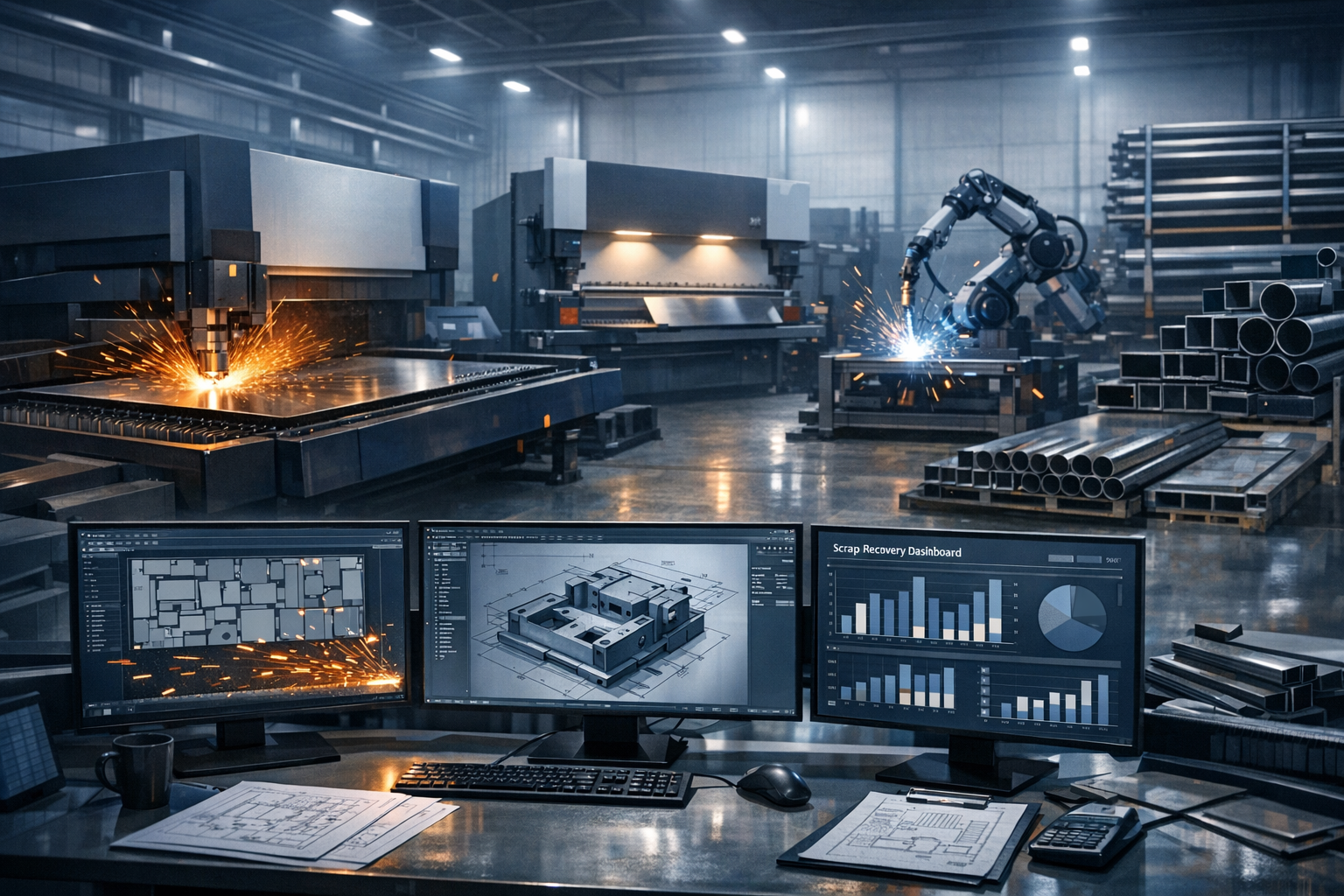
An effective IT strategy metals fabrication manufacturers UK programme has to do something most generic IT strategies skip: bring CAD/CAM, nesting, machine-tool data, scrap recovery, energy and embodied-carbon evidence into one coherent ERP-led plan, while keeping laser cutters, press brakes, punch presses and robotic welding cells running on three shifts. With the UK Steel Strategy published in March 2026, the UK Carbon Border Adjustment Mechanism (CBAM) coming into force on 1 January 2027, and the UK fabricated metal industry now worth around £42.3 billion in annual revenue, IT and digital decisions sit at the heart of competitiveness, compliance and decarbonisation.
Last updated: 9 May 2026
What an IT strategy metals fabrication manufacturers UK roadmap must cover
UK metals and fabrication is a structurally important sector under intense pressure. According to UK Steel and Make UK, domestic steelmakers’ share of UK steel demand has slumped to around 30%, with continuous flows of subsidised imports and high energy costs squeezing producers. The wider fabricated metal industry remains one of the largest manufacturing segments by revenue, providing static and assembled metal products to construction, defence, automotive, infrastructure, food, white goods and energy customers across the UK.
An IT strategy metals fabrication manufacturers UK programme therefore has to cover seven domains:
- ERP and MRP with high-mix job-shop and engineer-to-order planning, including small-batch quoting and outsource flows.
- CAD/CAM, nesting and offcut management for sheet, tube and structural sections.
- Real-time shop-floor data from laser cutters, plasma, press brakes, punch presses, tube benders and robotic welding cells.
- Lot and heat-number traceability for steel, aluminium and stainless inputs from goods-in to dispatch.
- Energy, scope 1-3 carbon and SECR reporting, plus embodied-carbon evidence for CBAM and customer scopes.
- OT cybersecurity for connected machine tools, MES servers and vendor remote access.
- EDI and B2B integration with construction main contractors, automotive Tier 1s, defence primes, aerospace OEMs and infrastructure customers.
Treating these as separate projects is the most common failure mode. The IT strategy metals fabrication manufacturers UK plan should bring them onto one roadmap, with one technology leader accountable for the whole.
Why the UK Steel Strategy and CBAM reshape the IT brief
The UK Steel Strategy, published in March 2026, sets out a long-term direction towards electric arc furnace (EAF) production, scrap-led circularity and decarbonised steelmaking. Two policy levers in the strategy will reshape the IT brief for any UK metals or fabrication manufacturer:
- UK Carbon Border Adjustment Mechanism (CBAM) from 1 January 2027. Imports in scope of CBAM will face a carbon price equivalent to the UK Emissions Trading Scheme, and free allocations to UK CBAM sectors under the UK ETS will be phased out from 2027 onwards. UK fabricators must be able to evidence the embodied carbon of inputs, intermediates and finished goods.
- Melted-and-poured origin tracking. The government is exploring requirements to identify where steel imports are melted and poured, supporting both supply-chain transparency and trade-defence measures.
Together with new steel safeguards from 1 July 2026 and existing UK ETS coverage, this means the IT estate has to capture and report energy consumption, scope 1-3 emissions, scrap inputs and material origin per heat number and per finished part. Spreadsheets do not scale to that; an integrated IT and ERP plan does.
Sector-specific shop-floor and ERP capabilities for UK fabricators
UK fabricators are typically high-mix, low-to-medium volume engineer-to-order businesses, with lots of small jobs and a strong dependency on nesting and offcut recovery. The IT estate has to reflect this. Sensible priorities for an IT strategy metals fabrication manufacturers UK plan:
- Quote-to-cash automation. ERP and CAD-integrated quoting that prices cutting, bending, welding, finishing and assembly directly from the CAD model and current material costs.
- Nesting integration. Two-way integration between ERP and nesting software (Lantek, SigmaNEST, Radan, AlmaCAM, Hypertherm ProNest) so part demand drives nests and offcuts feed back into stock.
- Offcut and remnant management. Live tracking of usable offcuts by grade, thickness and remaining geometry, with policies for re-use and scrap.
- Heat-number and certificate traceability. Goods-in capture of mill certs (3.1 EN 10204) and full traceability from coil and plate through to finished part for aerospace, defence, automotive and pressure vessel customers.
- Real-time machine integration. Connectivity to fibre laser, plasma, waterjet, press brake, punch press, tube laser, beam line and robotic welding cells, with OEE, downtime and quality data captured at job level.
- Quality and certification records. CE/UKCA marking, EN 1090 execution class records, ISO 3834 welding quality, AS9100 (where defence/aerospace), pressure equipment directive (PED) records as required.
- Scrap and energy reporting. Real-time energy use per machine, integrated with ERP for SECR and CBAM reporting.
UK fabricators commonly run combinations of fabrication-specific ERPs (E-Max, Genius ERP, Lantek Integra, NexSys ERP+, Tempus and similar), CAD/CAM and nesting tools, and either built-in or integrated MES. Larger fabricators run mid-market ERPs like Microsoft Dynamics 365, Epicor Kinetic, Infor CloudSuite Industrial or SAP Business One alongside specialist nesting and CAM platforms.
Carbon, energy and how IT delivers measurable margin
UK fabrication is energy-intensive. Lasers, plasma cutters, induction heating, MIG/MAG welding, paint shops and shot-blast lines account for a substantial share of operating cost, and any reduction in scrap or energy flows directly to gross margin. A practical IT-led decarbonisation programme for an IT strategy metals fabrication manufacturers UK plan typically includes:
- Energy sub-metering at major asset level, integrated with the ERP and MES for per-job energy attribution.
- Scope 1-3 inventory tools, fed by ERP, supplier portals and energy data.
- Embodied-carbon calculation for finished parts using ISO 14067 and CBAM-compatible methodologies.
- Production scheduling that exploits time-of-use electricity tariffs, half-hourly metering and DSR opportunities.
- Predictive maintenance for compressors, lasers and welding power sources, reducing both downtime and energy waste.
- Digital twin and process simulation to optimise nesting, kerf and cutting parameters before steel hits the bed.
- Customer-facing carbon reporting linked to delivery notes and certificates, supporting EPDs and PCFs.
Many UK fabricators can find 5 to 12% of margin between waste reduction, energy optimisation and scrap recovery. The IT strategy is the mechanism that turns those opportunities from anecdote to balance sheet.
Cybersecurity for connected machine tools and welding cells
Modern fibre lasers, press brakes, robotic welding cells, beam lines and tube benders increasingly come with cloud connectivity, vendor remote support and IoT data feeds. The cyber implications are concrete. UK fabricators should align with the NCSC Operational Technology collection and the January 2026 Secure Connectivity Principles for OT, segregating machine networks from corporate IT, deploying phishing-resistant MFA at the OT boundary, and tightly controlling vendor remote access for major suppliers (Bystronic, Trumpf, Amada, Mazak, Salvagnini, ABB, Fanuc, KUKA, Lincoln Electric, ESAB).
For UK fabricators in defence supply, DEF STAN 05-138 cyber profiles and JOSCAR pre-qualification apply on top. Automotive Tier 1 fabricators should align to IATF 16949 and TISAX, and aerospace fabricators to AS9100 and Cyber Essentials Plus as a baseline. The IT strategy metals fabrication manufacturers UK plan should treat these as overlapping requirements rather than competing programmes.
How to choose a partner for a UK metals and fabrication IT strategy
Generic fractional CIO firms rarely understand nesting, mill certs or heat-number traceability. When choosing a partner, look for:
- Real fabrication experience, including laser, plasma, press brake, robotic welding and finishing environments.
- Working knowledge of EN 1090, ISO 3834, CE/UKCA marking, PED and AS9100 where appropriate.
- CAD/CAM and nesting integration experience with Lantek, SigmaNEST, Radan or equivalent.
- Vendor independence: no commission on ERP, MES, CAM or machine-tool vendors.
- Fixed-fee retainers, no long-term tie-in, board-ready communication.
- Track record with construction main contractors, automotive Tier 1s, defence primes, aerospace OEMs or infrastructure customers.
If the candidate cannot describe how a heat number flows from goods-in through nesting to a finished part and customer delivery note, they are not yet ready for a UK metals or fabrication engagement.
Frequently Asked Questions
What does an IT strategy for a UK metals or fabrication manufacturer have to cover?
It must cover ERP and MRP with high-mix job-shop planning, integration with CAD/CAM and nesting software, real-time shop-floor data from laser cutting, press brakes, punch presses, robotic welding cells and tube benders, lot and heat-number traceability for steel and stainless, scrap and offcut recovery management, energy and carbon reporting for SECR and the UK Carbon Border Adjustment Mechanism (CBAM), OT cybersecurity for connected machine tools and EDI to construction, automotive, aerospace and infrastructure customers.
How does the UK Steel Strategy affect IT planning for fabrication manufacturers?
The UK Steel Strategy published in March 2026 commits to electric arc furnace (EAF) production, scrap recycling and decarbonisation, and brings forward a UK Carbon Border Adjustment Mechanism (CBAM) on 1 January 2027. UK fabricators have to be able to evidence the embodied carbon of every steel mill product they buy and ship, as free allocations under the UK ETS phase out for sectors covered by CBAM. The IT strategy must therefore deliver auditable carbon and material origin data through ERP, MES and supplier records.
Which ERP and digital tools are best suited to UK metals and fabrication manufacturers?
UK fabrication manufacturers typically run a mix of fabrication-specific ERPs (such as E-Max, Genius ERP, Lantek Integra, NexSys ERP+ and similar), CAD/CAM and nesting tools (Lantek, SigmaNEST, Radan, AlmaCAM, Hypertherm ProNest), and MES platforms that connect laser cutters, press brakes, punch presses and welding cells. Larger fabricators may run mid-market ERPs like Microsoft Dynamics 365, Epicor Kinetic, Infor CloudSuite Industrial or SAP Business One alongside nesting and CAM, with integrations to PLM and engineering CAD.
What cybersecurity standards apply to UK metals and fabrication manufacturers in 2026?
At a minimum, UK metals and fabrication manufacturers should align to Cyber Essentials Plus, the NCSC Operational Technology guidance and the January 2026 Secure Connectivity Principles for OT, IEC 62443 for industrial control system security where appropriate, and ISO 27001 where customers demand it. Defence-supply fabricators must also meet DEF STAN 05-138 cyber profiles and JOSCAR pre-qualification, and automotive fabricators should align to IATF 16949 and TISAX expectations from European OEMs.
Take the Next Step
If you are a UK metals or fabrication manufacturer wrestling with nesting and CAM integration, ERP renewal, energy and carbon reporting or OT cybersecurity, Bailey & Associates can build the IT strategy metals fabrication manufacturers UK roadmap with you. We work exclusively with UK manufacturers, on a fixed monthly retainer from £2,000 per month with no tie-in and cancel-anytime terms. Fifteen-plus years of UK manufacturing IT experience including high-mix fabrication, vendor-neutral, board-ready. Learn more about our manufacturing IT services or book a free discovery call today.
