
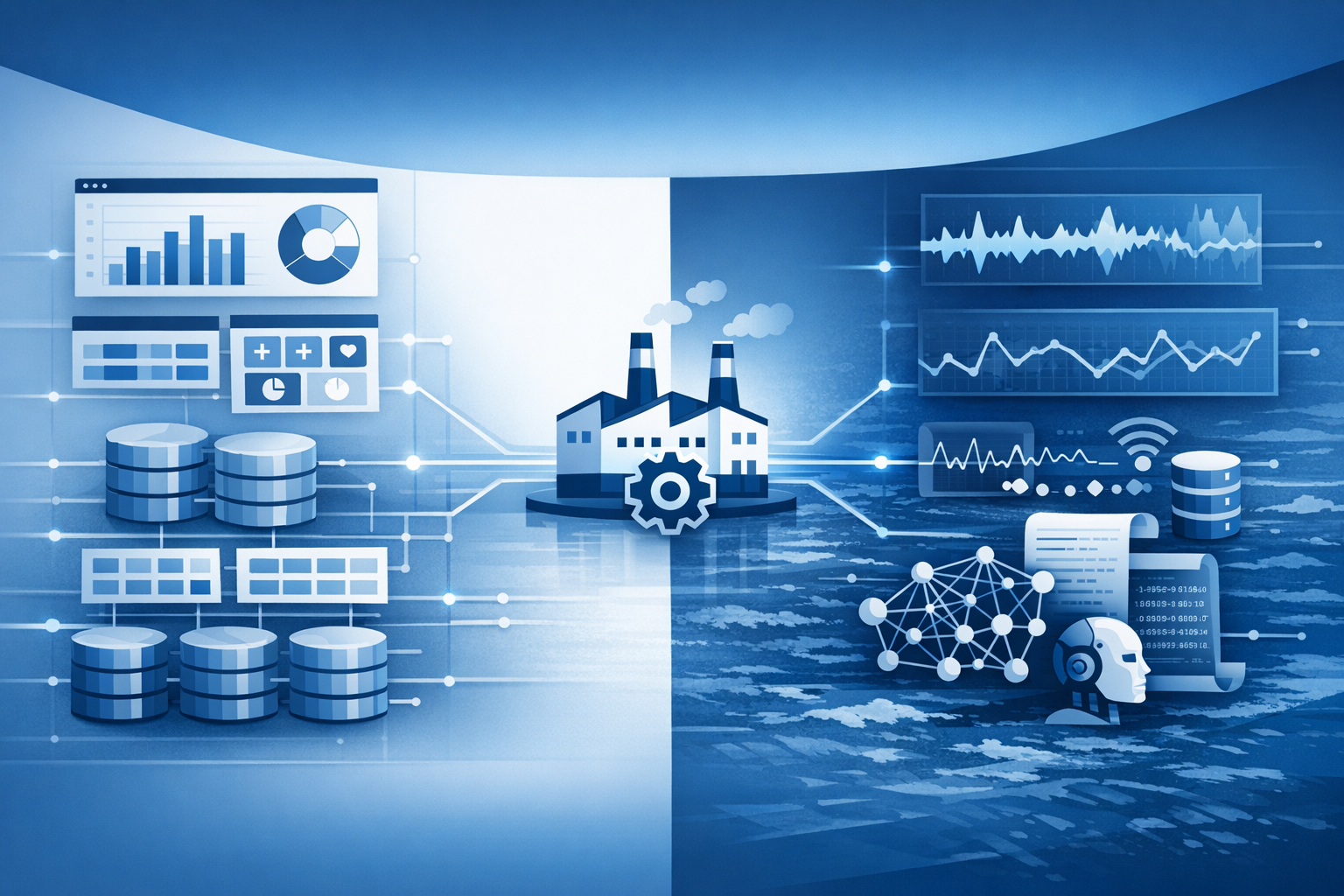
For most UK manufacturers, the data lake vs data warehouse manufacturing UK debate is not a binary choice but a sequencing question: a data warehouse handles structured BI from ERP, MES and finance for KPIs like OEE, scrap, margin and on-time delivery, while a data lake handles high-volume, semi-structured and unstructured data from SCADA, IoT, vision systems and documents for predictive maintenance, digital twin and AI use cases. Increasingly, both converge into a lakehouse architecture that supports both worlds on a single, governed platform.
Last updated: 19 May 2026
Data lake vs data warehouse manufacturing UK: the essentials
A data warehouse is a tightly controlled, schema-on-write environment that stores cleaned, structured data from operational systems such as ERP, MES, finance, CRM and quality. It is optimised for SQL, BI tools (Power BI, Tableau, Looker) and reliable, repeatable reporting. Examples include Microsoft Fabric Warehouse, Snowflake, Google BigQuery, Amazon Redshift and Azure Synapse SQL.
A data lake is a flexible, schema-on-read environment that stores raw data in its native format on low-cost object storage (Azure Data Lake, Amazon S3, Google Cloud Storage). It can hold structured tables alongside semi-structured logs, IoT time-series, MQTT and OPC UA streams, images, CAD files, PDFs and audio. Data scientists, ML engineers and AI tools work directly on the raw data using Python, Spark, Databricks, Synapse Spark, Snowpark or open notebooks.
The Databricks summary of data lakes vs data warehouses captures the core trade-off well: warehouses are great for structured BI but expensive and rigid; lakes are flexible and cheap but variable in performance and harder to govern without the right tooling. In practice, the data lake vs data warehouse manufacturing UK question is less “which one?” and more “in what order, and how do we govern the join?”.
Where each architecture wins on the shop floor
For UK manufacturers, the practical use cases divide fairly cleanly:
- Data warehouse strengths: board-level KPI reporting; OEE, scrap, yield, on-time-in-full, working capital and margin reporting; finance and management accounts; sales and supply chain analytics; customer and product profitability; compliance reporting such as ESG and energy intensity.
- Data lake strengths: high-frequency SCADA and IoT time-series; machine vision and quality image archives; predictive maintenance models; digital twin data feeds; AI and generative AI use cases; ingest of supplier portals, EDI, weather and other external feeds; long-term retention for audit and traceability.
- Where the two overlap: joining ERP and MES transactional data with SCADA and IoT data to understand why a particular batch under-yielded or which combination of operator, machine and material drives the best margin. Modern lakehouse platforms (Microsoft Fabric, Databricks Lakehouse, Snowflake Cortex) are explicitly designed for this overlap.
According to Made Smarter, UK manufacturers adopting connected digital technologies see measurable productivity, quality and energy gains. Almost all the headline AI and digital twin case studies under Made Smarter rely on combining structured warehouse data with raw lake-style telemetry, exactly the kind of join the data lake vs data warehouse manufacturing UK conversation should be unlocking.
Real-world manufacturing scenarios
A few concrete scenarios make the choice easier to discuss at the board:
Scenario 1: Food and drink manufacturer. The CFO wants reliable monthly reporting on volume, margin, waste and on-time delivery from ERP and MES. The operations director wants real-time OEE, downtime root-cause and energy per tonne from SCADA and IoT. A data warehouse covers the CFO’s needs cleanly. A lake or lakehouse is needed to deliver the operations director’s view at the granularity required.
Scenario 2: Aerospace component manufacturer. Customer audits demand 10-year traceability with linked CAD, FAI documents, inspection images, batch records and CMM measurements. A pure warehouse is too rigid; a pure lake is hard to govern. A lakehouse with strong data contracts, lineage and governance is usually the right answer, with the warehouse layer feeding management KPIs.
Scenario 3: Pharma or medical device manufacturer. MHRA expects ALCOA+ data integrity, GxP-validated systems and electronic batch records. The right pattern is typically a validated warehouse for GxP-critical reporting, alongside a governed lake for non-GxP advanced analytics, with clear segregation and audit between the two.
Scenario 4: Discrete fabrication or electronics SME. The dominant pain is “I cannot get one trustworthy version of the truth across ERP, CRM and spreadsheets”. The right first step is usually a simple, well-governed data warehouse fed from ERP, MES and finance, with a small lake layer added later for SCADA, IoT and AI use cases as the business matures.
What to look for in a data lake vs data warehouse manufacturing UK decision
This is one of the more strategic and easier-to-overspend IT decisions a UK manufacturer makes. Before committing to a platform or vendor, run through a checklist:
- Anchor on outcomes, not technology. Start from three or four board-level questions or KPIs and work back. “We want a data lake” is a project that will not finish; “we want OEE, scrap and margin reliably reported every month and a predictive maintenance model on our most expensive line” will.
- Data sources first. Map what you have: ERP, MES, SCADA, historian, CMMS, eQMS, LIMS, PLM, finance, CRM, IoT. Confirm what is currently extractable, what needs new connectors, and where data quality is weak.
- Cost model. Storage is cheap; compute is not. A pure data warehouse with 24×7 BI dashboards on premium SKUs can quietly become a 6-figure annual line item. A lakehouse on open formats (Delta, Iceberg, Parquet) and pay-per-query compute is often cheaper at scale.
- Governance and lineage. Catalog, data quality, lineage and access control are non-negotiable. ICO UK GDPR guidance still applies to any personal data in HR, CRM, customer or operator records, regardless of whether it sits in a lake or a warehouse.
- Cyber security. Aligned to NCSC Cyber Essentials as a baseline and ISO 27001 where required by customers. Lakes are particularly exposed to wide-open access patterns if not designed carefully.
- Data residency. For UK manufacturers in defence, healthcare or public-sector supply, UK or EEA data residency is often a hard requirement. Confirm tenant and storage regions in the contract, not just on the marketing site.
- Skills and operating model. Warehouses suit SQL-led BI teams; lakes need engineers comfortable with Python, Spark and data ops. A lakehouse needs both. Budget for the people, not just the licence.
- Open formats and exit. Insist on open table formats (Delta, Iceberg, Parquet) and clear export paths. The cost of getting out of a proprietary closed warehouse can dwarf the cost of getting in.
How the data lake vs data warehouse manufacturing UK decision usually plays out
Across UK SME manufacturers, three patterns are now common:
Pattern A: Warehouse first. Best for businesses where ERP and finance reporting is the binding constraint and IoT data is limited. Start with a modest cloud data warehouse fed from ERP, MES, finance and CRM. Build core management KPIs in Power BI. Add a lake layer in year two as IoT and AI use cases mature.
Pattern B: Lakehouse first. Best for businesses already drowning in SCADA, IoT, image and historian data, or with ambitious digital twin and predictive maintenance plans. Start with a lakehouse on Microsoft Fabric, Databricks or Snowflake. Build the warehouse layer as governed gold tables for BI. This is increasingly the default for digitally-mature manufacturers and Made Smarter beneficiaries.
Pattern C: Hybrid evolution. Many UK manufacturers have a legacy on-premise warehouse and a new cloud lake running in parallel. The pragmatic move is to converge towards a single lakehouse over 12 to 24 months, retiring the legacy warehouse once parity is reached, rather than running two stacks indefinitely.
The wrong move, in nearly every case, is to let each line of business pick its own platform and end up with three lakes, two warehouses, a historian, a homegrown SQL server and seven copies of “the truth”.
Where senior leadership fits in
The biggest risk in a data lake vs data warehouse manufacturing UK decision is not the technology. It is the absence of senior, vendor-independent leadership to define scope, push back on vendor hype, integrate cleanly with ERP, MES and SCADA, govern access and security, and bring finance, operations and IT along the journey. A fractional IT director can own the architecture decision, vendor selection and integration plan, and protect the budget when the inevitable scope creep arrives.
Frequently Asked Questions
What is the difference between a data lake and a data warehouse in manufacturing?
A data warehouse stores structured, cleaned and modelled data optimised for business intelligence, KPI reporting and traditional analytics: typically ERP, MES, finance and CRM data. A data lake stores raw, semi-structured and unstructured data in its native format: IoT and SCADA telemetry, machine logs, images, video, CAD files and documents. Warehouses use schema-on-write and SQL; lakes use schema-on-read and a wider toolset including Python, Spark and machine learning. Most modern UK manufacturers end up needing both, often combined as a lakehouse.
Which is better for a UK manufacturer, a data lake or a data warehouse?
Neither is universally better. A data warehouse is the right answer when your priority is reliable BI from ERP, MES and finance for board KPIs, OEE, scrap, on-time delivery and margin. A data lake is the right answer when you need to combine high-volume IoT, SCADA and image data for predictive maintenance, quality and digital twin use cases. For most UK SME manufacturers the practical answer is a lakehouse architecture: one platform that supports both BI and machine learning on the same governed data, with lower cost and less duplication than running separate stacks.
What is a lakehouse and why does it matter for manufacturing?
A lakehouse is an architecture that combines the flexibility and low storage cost of a data lake with the performance, governance and reliability of a data warehouse on a single platform. For manufacturers, that means ERP transactions, MES work orders, SCADA time-series, IoT sensor streams, quality images and documents all live in one governed environment, queryable with SQL for BI and with Python or Spark for ML. It typically reduces total cost of ownership compared with running a separate warehouse plus lake plus historian, and accelerates AI use cases such as predictive maintenance, energy optimisation and quality vision systems.
Where does an ERP or MES fit in a data lake vs data warehouse decision?
ERP and MES are operational source systems, not the warehouse or the lake. ERP runs the business (orders, finance, planning), MES runs the shop floor (work orders, OEE, traceability). Their data is typically extracted into a data warehouse for structured BI, and increasingly also into a data lake or lakehouse so it can be joined with high-volume IoT, SCADA and quality data for advanced analytics, AI and digital twin use cases. Done well, the warehouse, lake or lakehouse sits downstream of ERP and MES, never replaces them.
Take the Next Step
Designing the right data lake vs data warehouse manufacturing UK architecture is one of the highest-leverage IT decisions a UK manufacturer can make, and one of the most expensive to get wrong. Bailey & Associates provides fractional IT director cover specifically for UK manufacturers, with 15+ years of sector experience, fixed monthly pricing from £2,000 per month and cancel-anytime terms. Explore our manufacturing IT services or book a free discovery call today.
