
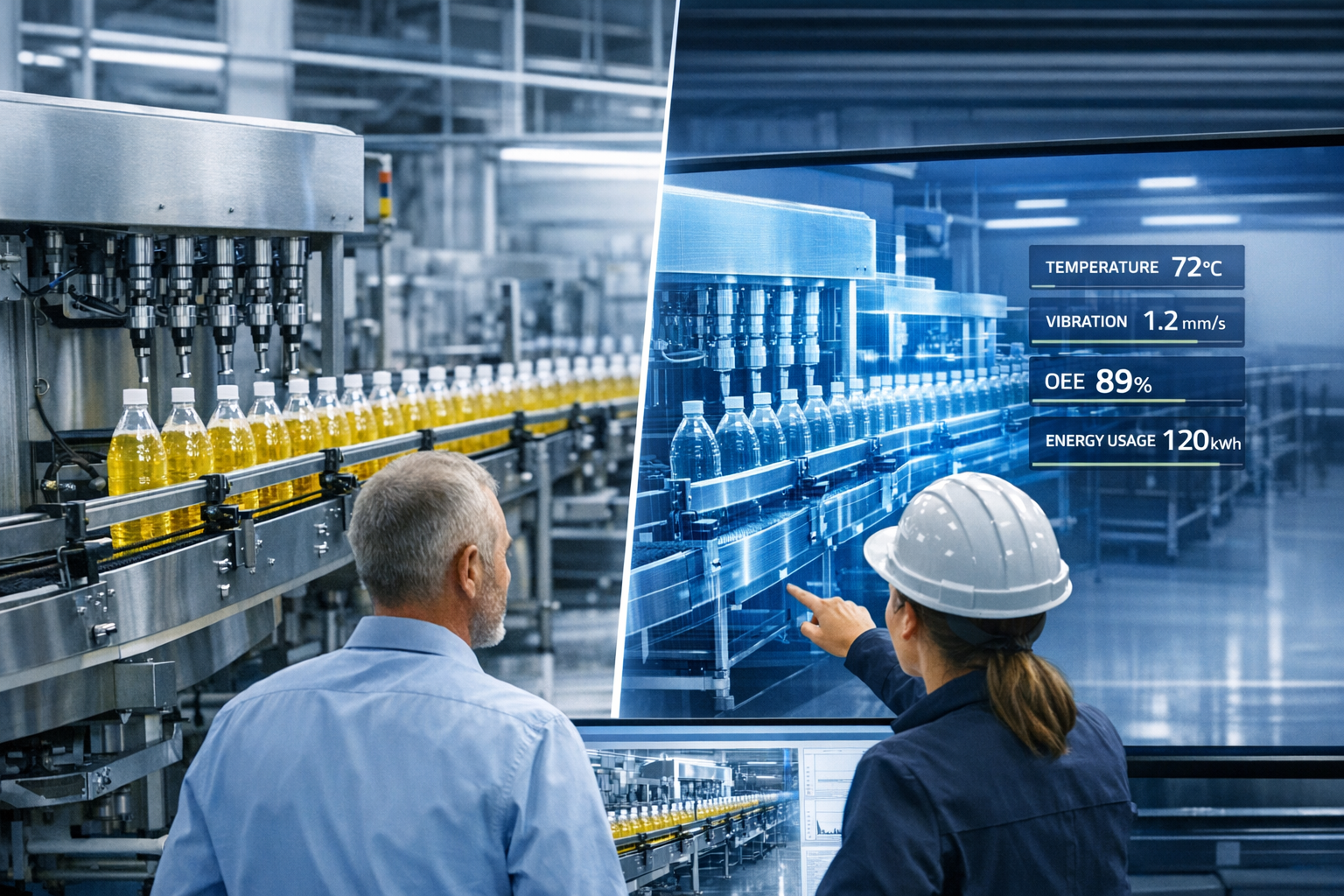
A digital twin in manufacturing is a live, data-driven virtual replica of a physical component, machine, line, factory or supply chain, continuously updated with real-time data from sensors, PLCs, SCADA, MES and ERP. For UK manufacturers, a digital twin in manufacturing is the layer that lets engineers and managers monitor, simulate and optimise the shop floor without interrupting production, and provides a safe sandbox to predict failures, model new products and test changes before money is spent.
Last updated: 18 May 2026
What is a digital twin in manufacturing and how is it different from a simulation?
A digital twin in manufacturing is far more than a CAD drawing or a one-off simulation. It is a dynamic, always-on model of a physical thing in the real world, kept synchronised with that thing through a constant feed of live data. Where a traditional simulation might be built once for a project and then archived, a digital twin lives for the entire operational life of its physical counterpart, learning and improving as more data is gathered.
According to IBM’s definition of digital twin, the technology brings together IoT, AI, machine learning and software analytics with spatial network graphs to create living digital models that update and change as their physical counterparts change. In a factory, that translates to a virtual model of a bearing, motor, robot, line or plant that always reflects what is actually happening, not what someone typed into a spreadsheet last quarter.
The clearest way to explain a digital twin in manufacturing to a board is this: it is the difference between looking at a photograph of your factory and looking through a window into it that also lets you see the future.
The four main types of digital twin in manufacturing
Most analysts and vendors group manufacturing digital twins into four layered types. Each builds on the data and lessons from the layer below it:
- Component twin. A single part such as a bearing, valve, motor, pump or PCB. Useful for failure prediction, wear modelling and supplier qualification.
- Asset twin. A complete machine or piece of equipment such as a CNC cell, oven, filler, robot or pasteuriser. Used for OEE, predictive maintenance and operator training.
- System or unit twin. A connected group of assets that work together, such as a packaging line, a paint plant or a compressed-air system. Used for throughput optimisation, bottleneck analysis and energy management.
- Process or factory twin. A complete process, factory or even multi-site network, integrating MES, SCADA, ERP and supply chain data. Used for capacity planning, scenario modelling, sustainability reporting and resilience.
Most UK manufacturers start at component or asset level, where the data is cleanest and the ROI is most visible, then grow into system and process twins once the data foundations are in place.
Why a digital twin in manufacturing matters for UK CEOs and MDs
For a UK manufacturing CEO or MD, a digital twin is not a research project. It is a tool for hard commercial outcomes. The most common reasons UK manufacturers invest in digital twin technology are:
- Predictive maintenance and uptime. Real-world programmes consistently report 25 to 50 percent reductions in unplanned downtime and 10 to 40 percent reductions in maintenance cost.
- Scrap and rework reduction. 10 to 20 percent material-waste cuts are typical on heat, forming and coating processes once a digital twin steers operating envelopes.
- Energy and net-zero performance. 15 to 40 percent fuel and electricity savings on ovens, furnaces and HVAC, directly supporting net-zero commitments and reducing exposure to UK carbon taxation.
- Throughput and OEE. Double-digit OEE gains as twins identify bottlenecks, recommend cycle changes and balance lines.
- Faster new product introduction. Virtual trials replace expensive physical trials, with some manufacturers reporting NPI cycle times halved.
- Supply chain resilience. Process twins fuse ERP, IoT and external risk signals, enabling manufacturers to model shocks before they hit the P&L.
- Operator training and safety. Engineers and operators can train and rehearse on the twin, including dangerous or rare scenarios, without putting people or product at risk.
According to the Made Smarter case studies, 97 percent of supported UK SME manufacturers report productivity benefits from digital projects, with digital twin, IIoT and predictive maintenance featuring strongly. Made Smarter Adoption is squarely in scope for digital twin work for eligible SME manufacturers across England, Scotland, Wales and Northern Ireland.
How a digital twin in manufacturing actually works
Behind every credible digital twin sits a fairly simple stack. At the bottom, instrumented physical assets generate data via PLCs, sensors and IIoT gateways. That data travels through SCADA, MES and a historian or time-series database. A modelling layer (physics-based, data-driven, AI/ML or a hybrid) consumes the live data and continuously updates the virtual model. A visualisation and analytics layer presents the twin to engineers, operators and managers through 3D, 2D, dashboards and APIs into ERP, CMMS and BI tools.
In practice, a manufacturer’s first digital twin might look like this: vibration, temperature and motor-current sensors on a critical pump feed a cloud platform. A machine-learning model spots early signs of bearing wear and predicts the optimal intervention window. The CMMS automatically raises a work order three weeks before the pump would fail, scheduled into the next planned shutdown. The result: one fewer unplanned line stop, one fewer mid-shift call-out, one less customer escalation.
Scale that pattern across critical assets, lines, energy systems and the supply chain and you start to see why digital twin in manufacturing is now treated as a strategic capability rather than a science project.
Digital twin vs simulation, IIoT, MES and ERP
Manufacturing boards often ask how digital twin sits alongside other systems. A simple way to think about it:
- Simulation is a model of how something might behave under stated conditions, usually built once for a project.
- Digital twin is a live model of how something is behaving right now, continuously updated from real-world data.
- IIoT and sensors are the data source that keeps the digital twin synchronised.
- SCADA and historian are the systems that collect, label and store that data.
- MES uses that data to manage work orders, OEE and traceability on the shop floor.
- ERP uses summarised actuals from MES and the twin to plan, cost and report at business level.
A digital twin is not a replacement for any of these. It is what sits on top, turning their data into foresight.
What to look for when starting a digital twin project
Digital twin projects are easier to start badly than well. A few practical checks before you commit serious budget:
- One clear business outcome. Downtime, energy, scrap, throughput or NPI time. If the answer is “we want a digital twin”, stop and re-scope.
- Data readiness. Clean, time-stamped data from SCADA, MES and IIoT sensors, with a historian or time-series database that you actually trust.
- Open APIs. Avoid platforms that lock your data in a proprietary format. Open APIs, MQTT, OPC UA and standard time-series formats are non-negotiable.
- Minimum viable twin. Start with one asset or line. Build the simplest twin that proves the business case. Add physics fidelity only when incremental value is proven.
- Cyber and resilience. Aligned to NCSC operational technology guidance, IEC 62443 and Cyber Essentials Plus. A digital twin that becomes a live attack surface is worse than no twin at all.
- Cross-functional ownership. Operators, maintenance engineers, IT, OT and data scientists working to a shared KPI. The biggest digital twin failure mode is leaving it as “the data team’s project”.
- Total cost of ownership. Licences, infrastructure, integration, training and your own internal time. Three- and five-year TCO matter more than first-year cost.
Where Made Smarter, funding and senior leadership fit in
Digital twin projects are squarely in scope for the Made Smarter Adoption programme, which co-funds digital technology investments and pairs them with leadership development and specialist advice for eligible UK SME manufacturers. Made Smarter is delivered through regional partners across England, Scotland (with leadership delivered by Heriot-Watt University), Wales and Northern Ireland.
The biggest risk in a digital twin programme is not the software. It is the absence of senior, vendor-independent leadership to define scope, hold the vendor and integrator accountable, integrate cleanly with ERP, MES and SCADA, and bring operations, engineering and IT along the journey. A fractional IT director can own the technology assessment, vendor selection and integration plan that sit behind a successful digital twin project and protect the match-funded budget.
Frequently Asked Questions
What is a digital twin in manufacturing in simple terms?
A digital twin in manufacturing is a live virtual replica of a physical thing such as a component, machine, production line, factory or supply chain, kept up to date with real-time data from sensors, PLCs, SCADA, MES and ERP. It lets engineers and managers monitor, simulate and optimise what is happening on the shop floor without disrupting actual production, and it provides a safe environment to test changes, predict failures and model new products before money is spent in the real world.
What are the main types of digital twin used in manufacturing?
There are four widely recognised types. A component twin models a single part, such as a bearing or motor. An asset twin models a complete machine or piece of equipment, such as a filler, oven or CNC cell. A system or unit twin models a connected group of assets, such as a production line or utility system. A process or factory twin models an entire process, factory or even multi-site network, integrating MES, SCADA, ERP and supply chain data. Most UK manufacturers start at component or asset level and grow into system and process twins as data, skills and ROI improve.
What is the ROI of a digital twin in manufacturing?
Real-world results from UK and global manufacturers consistently show 10 to 20 percent reductions in scrap and rework, 25 to 50 percent reductions in unplanned downtime through predictive maintenance, 15 to 40 percent energy savings on heat-intensive processes, and double-digit improvements in OEE and time-to-market for new products. The Made Smarter Adoption programme reports that 97 percent of supported UK SME manufacturers see productivity benefits from digital projects, including digital twin use cases.
How do I start with a digital twin in a UK SME manufacturer?
Start small, with one high-value asset or line and one clearly defined business outcome (typically downtime, energy, scrap or throughput). Make sure you have a clean source of real-time data, usually from SCADA, MES or IIoT sensors, and a historian or time-series database. Build a minimum viable digital twin on open APIs to avoid vendor lock-in, anchor the use case to a board-level KPI, and validate the model monthly against ground-truth data. Made Smarter Adoption co-funds eligible UK SME manufacturers, and most successful first projects pay back inside 12 to 18 months.
Take the Next Step
Starting a digital twin in manufacturing is one of the highest-leverage IT-OT decisions a UK manufacturer can make, and one of the easiest to get wrong without senior, vendor-independent leadership. Bailey & Associates provides fractional IT director cover specifically for UK manufacturers, with 15+ years of sector experience, fixed monthly pricing from £2,000 per month and cancel-anytime terms. Explore our IT-OT integration and Industry 4.0 readiness services or book a free discovery call today.
