
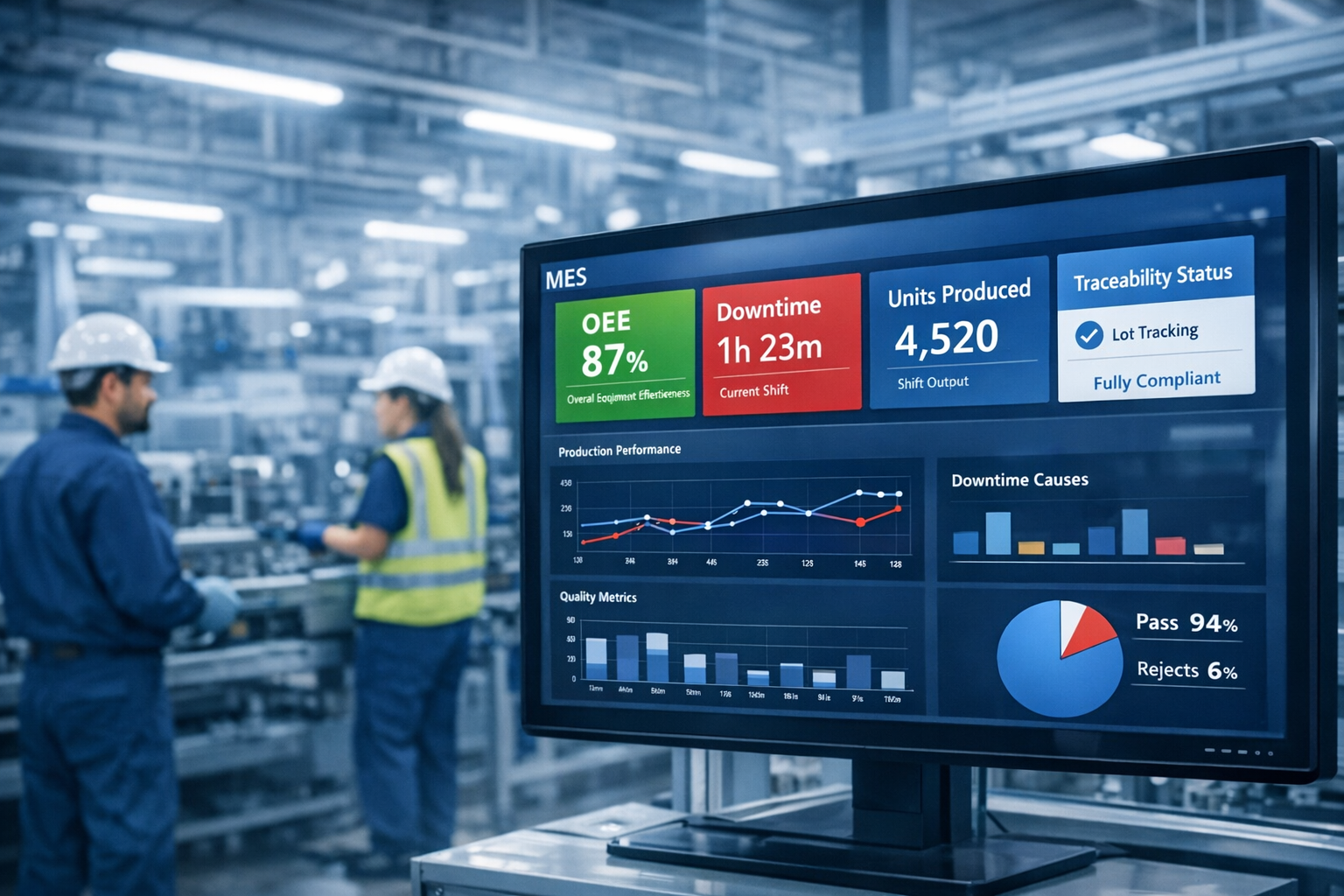
MES in manufacturing stands for Manufacturing Execution System: software that tracks, controls and records what happens on the shop floor in real time, sitting between your ERP system and the machines, operators and quality checks that actually make product. For UK manufacturers, MES in manufacturing is the layer that turns paper job cards, clipboards and spreadsheets into reliable digital data on output, downtime, traceability and quality.
Last updated: 15 May 2026
What is MES in manufacturing and where does it sit?
MES is short for Manufacturing Execution System. It is shop-floor software that knows, at any given moment, which work order is running on which machine, who is operating it, how fast it is going, what quality data has been captured and what raw materials have been consumed. Where ERP answers “what should we be making this week and is it profitable?”, MES answers “what is actually happening on the line right now?”.
The international reference point is the ISA-95 standard, which divides a manufacturing business into five levels. Sensors and intelligent devices sit at Level 1. PLCs, DCS and SCADA sit at Level 2. MES sits at Level 3, managing manufacturing operations. ERP sits at Level 4, running business planning and logistics. By placing MES at Level 3, ISA-95 makes clear that MES is the connective tissue between the office and the factory floor.
In a UK manufacturing context, MES in manufacturing typically replaces a tangle of paper job travellers, Excel OEE trackers, downtime whiteboards, lab notebooks and bespoke Access databases with a single, real-time digital backbone.
Why MES in manufacturing matters for UK CEOs and MDs
For a manufacturing CEO or MD, MES is not a technical curiosity. It is the difference between running the factory on hard data and running it on hope. The most common reasons UK manufacturers invest in MES are:
- Trustworthy OEE. Real Overall Equipment Effectiveness numbers, captured automatically, not estimated by line leaders at the end of a shift.
- Full batch traceability. Forward and backward traceability from raw material lot to finished pallet, essential for BRCGS, MHRA, AS9100, IATF 16949 and own-label retailer audits.
- Right-first-time quality. In-line quality checks, SPC and non-conformance management embedded in the work order, not bolted on after the event.
- Paperless shop floor. Electronic job cards, work instructions and SOPs at the machine, with version control and audit trail.
- Faster, cleaner ERP. Real production data feeding back to ERP for scheduling, costing and stock, instead of overnight imports of typed-up spreadsheets.
- Better labour and machine planning. Live visibility of who and what is available, and where the bottlenecks really are.
- Lower compliance risk. A defensible electronic record for HMRC, MHRA, FSA, BRCGS, ICO and customer auditors.
According to Made Smarter, manufacturers that adopt connected digital technologies such as MES typically report measurable productivity gains, reduced waste and faster response to customer changes. For most UK SME manufacturers, an MES project sits squarely inside the Made Smarter Adoption funding scope.
How MES in manufacturing actually works
A typical MES collects data from three sources: machines (via PLCs, OPC UA, MQTT or direct sensor feeds), operators (via touchscreens, scanners and tablets), and other systems (ERP, PLM, eQMS, LIMS, MRP). It then does four things with that data:
Dispatch and execute work orders. ERP sends planned production orders to MES. MES schedules them against machines, tooling, people and materials, dispatches them to the line, and walks the operator through the work instructions step by step. Job cards become electronic, with the right drawing, recipe or programme automatically loaded.
Capture production events in real time. Every cycle, every reject, every micro-stop, every changeover, every quality check is captured against the work order. The system continuously calculates OEE, scrap, yield, cycle time and other KPIs.
Enforce process and quality rules. MES will not let an operator start a job without the correct training, materials or calibration. It triggers in-process inspections, non-conformance workflows and corrective actions. For regulated sectors, it enforces electronic batch records and ALCOA+ data integrity.
Feed everything back to ERP and BI. Actual consumption, actual labour, actual yield and actual completion are reported back to ERP so finance, planning and customer service work from real numbers. The same data flows to Power BI or another analytics tool for board-level reporting.
MES vs ERP, SCADA and PLM
One of the most common questions UK manufacturing boards ask is how MES fits with the other three-letter systems on the slide deck. A simple way to think about it:
- ERP runs the business: orders, finance, planning, stock, purchasing, payroll.
- MES runs the execution: work orders, machines, operators, real-time quality, traceability, OEE.
- SCADA and PLC run the equipment: cycle control, set points, alarms, interlocks.
- PLM runs the product: BoM, drawings, ECNs, revision control, design data.
- LIMS / eQMS run laboratory and quality management: tests, CAPAs, audits, calibrations.
MES talks to all of them. Done well, it becomes the operational heartbeat of the factory and the single source of truth for “what really happened” on the shop floor.
What to look for when choosing an MES in the UK
Choosing an MES is one of the higher-stakes IT decisions a UK manufacturer makes, with project costs typically running from £60,000 to £500,000+ depending on scope, sites and integration. A few things to check before you sign anything:
- Fit for your sector. Food and drink, pharma, aerospace, automotive, fabrication and electronics all have different traceability, quality and compliance demands. A good vendor will show reference customers in your sector.
- ISA-95 alignment. The system should map cleanly to ISA-95 Level 3 and integrate to Level 4 ERP without bespoke spaghetti.
- Open integration. Native support for OPC UA, MQTT, REST APIs and common ERP connectors (SAP, Microsoft Dynamics 365, IFS, Epicor, NetSuite, Infor, Sage). Closed, proprietary integrations age badly.
- Configurable, not custom. You want a platform you can configure as your processes evolve, not a custom build that needs the vendor every time you change a work instruction.
- Cyber-secure by design. Aligned to NCSC Operational Technology guidance, with proper user authentication, role-based access, audit logging and patch management.
- Total cost of ownership. Licences, infrastructure, integration, training, support and your own internal time. Three-year and five-year TCO matter more than first-year cost.
- Realistic timeline. A first MES rollout typically takes 6 to 12 months for a single site. Anyone promising 8 weeks for a multi-site, multi-line, multi-recipe deployment is selling slideware.
Where Made Smarter and funding fit in
For UK SME manufacturers, MES projects are squarely within the scope of the Made Smarter Adoption programme, which co-funds digital technology projects and pairs them with leadership development and specialist advice. Made Smarter is delivered through regional partners across England (the North West, North East, Yorkshire and the Humber, the West Midlands, the East Midlands, the South East, the South West and London), Scotland (with leadership delivered by Heriot-Watt University), Wales and Northern Ireland.
The right play is usually to engage senior technology leadership before the funding application. A fractional IT director can own the technology assessment, vendor selection and integration plan that sit behind a successful Made Smarter project and protect the match-funded budget once the work starts.
Frequently Asked Questions
What is MES in manufacturing in simple terms?
MES stands for Manufacturing Execution System. It is software that sits between your ERP system and the shop floor, tracking what is being made, by whom, on which machine, to what quality and at what speed in real time. It turns paper job cards, spreadsheets and operator clipboards into live digital data that managers and the ERP can both rely on.
What is the difference between ERP and MES?
ERP runs the business (orders, finance, planning, stock, purchasing). MES runs the execution of those orders on the shop floor (work orders, machines, operators, quality, traceability). Under the ISA-95 standard, ERP sits at Level 4, MES at Level 3, and SCADA/PLC at Levels 1 and 2. A well-integrated MES feeds real production data back to ERP so planning is based on what is actually happening, not last week’s spreadsheet.
What are the main functions of an MES?
The ISA-95 and MESA-11 standards define around eleven core functions: data collection, scheduling and dispatch, resource and personnel management, product tracking and genealogy, quality management, process and document management, performance analysis (including OEE), and maintenance management. In practice, most UK manufacturers start with electronic job cards, OEE, traceability and quality, then add the rest over time.
Do UK SME manufacturers really need an MES?
If you rely on paper job cards, spreadsheets or operator memory to know what is happening on the shop floor, an MES will almost certainly pay back. UK SME manufacturers typically introduce an MES when they outgrow ERP-only operation, need full batch traceability for BRCGS, MHRA or aerospace customers, or want reliable OEE data. The Made Smarter Adoption programme co-funds MES and digital projects for eligible SME manufacturers across England, Scotland, Wales and Northern Ireland.
Take the Next Step
Choosing and implementing an MES in manufacturing is one of the most important IT decisions a UK manufacturer can make, and one of the easiest to get wrong without senior, vendor-independent leadership. Bailey & Associates provides fractional IT director cover specifically for UK manufacturers, with 15+ years of sector experience, fixed monthly pricing from £2,000 per month and cancel-anytime terms. Explore our ERP and digital transformation strategy services or book a free discovery call today.
