
A manufacturing technology roadmap UK 2027 deadline demands is no longer optional. The UK Government’s Industrial Strategy aims to nearly double annual manufacturing investment from 21 billion to 39 billion pounds by 2035, with 3 billion pounds in R&D and capital funding committed over the next four years. At the same time, new cybersecurity regulations take effect, ERP vendors are ending support for legacy platforms, and 60% of manufacturers are increasing investment in AI and automation. The manufacturers who enter 2027 without a technology roadmap will find themselves reacting to these changes rather than shaping them — and in manufacturing, reactive means expensive.
Last updated: 20 April 2026
What Is Changing for UK Manufacturers Before 2027
Several converging forces make the next 18 months a critical window for technology planning. Each of these changes independently justifies investment. Together, they create an environment where manufacturers without a roadmap face compounding risk:
The UK Industrial Strategy is reshaping the sector. The Advanced Manufacturing Sector Plan, published as part of the UK’s Modern Industrial Strategy, commits to giving UK firms an edge in six advanced manufacturing industries. The plan targets nearly doubling annual business investment in the sector and explicitly calls for digital adoption, automation, and AI as priorities. Made Smarter funding has been expanded, with 40 million pounds for robotics adoption hubs across the UK. Manufacturers who align their technology investments with these priorities are positioned to access funding and competitive advantage; those who do not will fall further behind global peers.
Cybersecurity compliance is becoming mandatory. The UK Cyber Security and Resilience Bill introduces expanded obligations for manufacturers, including stricter incident reporting and higher penalties — up to 17 million pounds or 4% of worldwide turnover. NIS2 applies to manufacturers serving EU markets. The UK Cyber Governance Code of Practice expects board-level ownership of cyber risk. By 2027, cybersecurity compliance will be a commercial and regulatory requirement, not a voluntary best practice.
Legacy ERP systems are reaching end of life. SAP ECC, older versions of Microsoft Dynamics, and several mid-market ERP platforms are approaching or have passed their end-of-mainstream-support dates. Manufacturers still running these systems face rising support costs, increasing security exposure, and diminishing vendor investment. An ERP migration takes 12 to 18 months — which means manufacturers who need to be on a modern platform by 2027 must be well into the selection process by now.
AI adoption is accelerating. The Make UK / PwC Executive Survey 2026 found that 60% of manufacturers are increasing investment in digital technologies, AI, and automation. But only 16% regard themselves as knowledgeable about AI’s potential uses in manufacturing. The gap between ambition and readiness is a roadmap problem — manufacturers need a plan that connects AI investment to data infrastructure, skills, and production outcomes rather than purchasing tools without preparation.
Investment intensity is at a decade low. RSM’s Investment Monitor reports that manufacturing investment intensity — the proportion of turnover invested in plant, machinery, and technology — has dropped to its lowest level since 2017. Yet at the same time, technology costs are rising faster than almost any other category. This means every pound of IT investment must work harder. A roadmap ensures that limited budget goes to the highest-impact initiatives rather than being spread reactively across whatever breaks next.
What a Manufacturing Technology Roadmap UK 2027 Must Cover
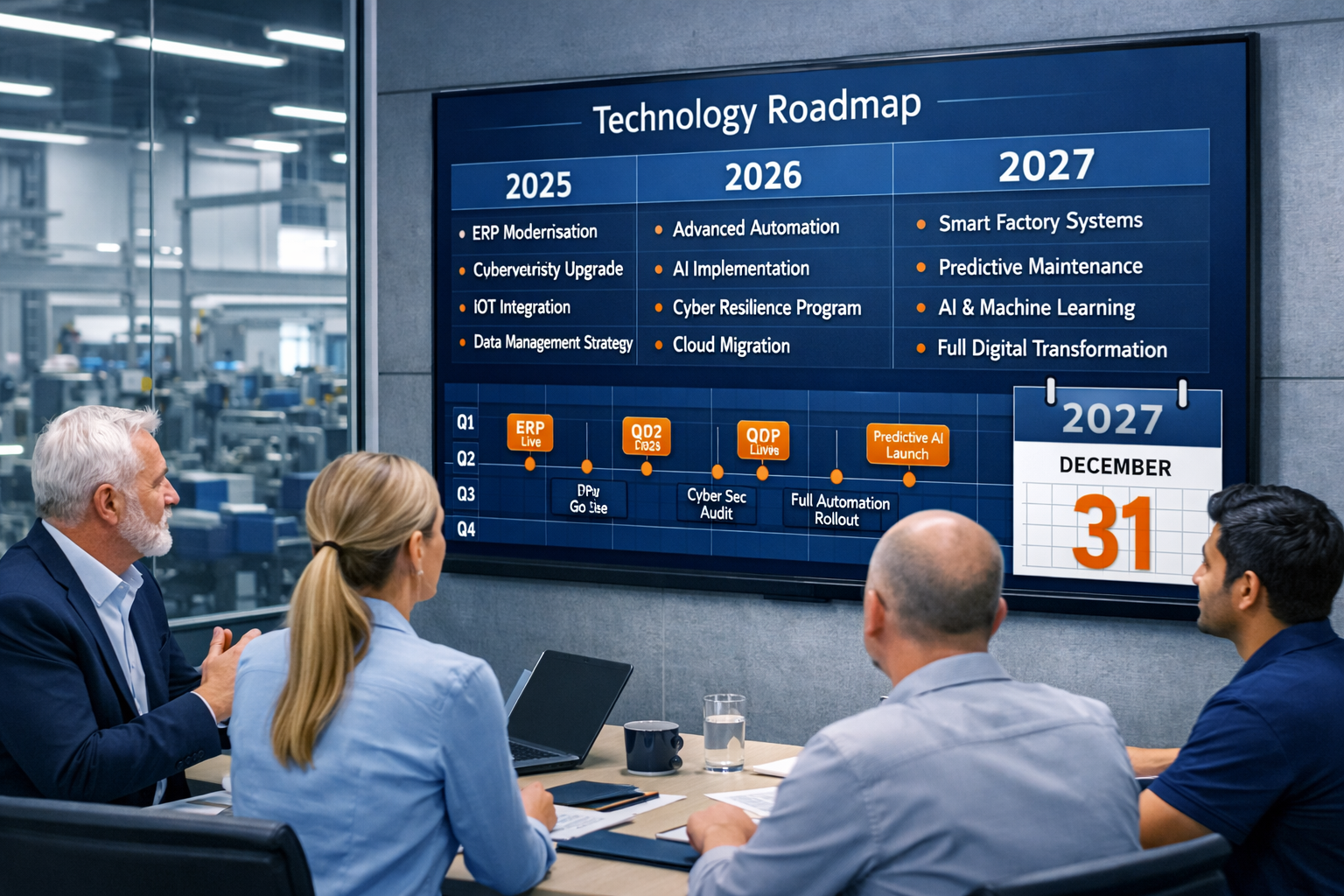
A credible manufacturing technology roadmap UK 2027 businesses need should address six domains, phased across the next 18 months:
- ERP and business systems: Is your current ERP supported, fit for purpose, and capable of serving your business through to 2030? If not, what is the replacement plan, and can it be completed by 2027? This includes evaluation, selection, implementation, and data migration — a 12 to 18-month programme that must start now if your current system is at risk.
- Cybersecurity and compliance: Where do you stand against the UK Cyber Governance Code of Practice and NIS2 requirements? Do you have Cyber Essentials Plus certification? Is your OT network segmented from corporate IT? Can you meet the 24-hour incident reporting requirement? A cybersecurity gap analysis and remediation plan is a non-negotiable part of the roadmap.
- OT/IT convergence: How well are your production systems — SCADA, MES, PLCs — connected to your business systems? Can you get real-time production data into your ERP for planning, costing, and reporting? The roadmap should define specific integration initiatives that bridge the shop floor and the office.
- AI and data readiness: What is your data quality like? Are your systems connected enough to feed AI models? The roadmap should include a data readiness assessment and a focused AI pilot before committing to larger investments. Starting with one use case — predictive maintenance or demand forecasting — and proving value before scaling is the approach that works.
- Vendor and cost management: When do your major IT contracts renew? Are you benchmarking vendor pricing against current market rates? A roadmap should include an annual vendor audit cycle and specific targets for cost optimisation. Manufacturers routinely save 15 to 25% through structured vendor reviews.
- Skills and governance: Who owns IT strategy in your organisation? Do you have an IT steering group? Do you report IT performance to the board? The roadmap should establish governance structures that ensure technology investment is managed strategically, not reactively.
Why 2027 Is the Deadline That Matters
The year 2027 is not an arbitrary target. It is the point at which several independent timelines converge:
The British Industrial Competitiveness Scheme launches in 2027, reducing electricity costs by up to 25% for qualifying manufacturing industries. The Lifelong Learning Entitlement rolls out in January 2027, enabling modular upskilling funded from the Growth and Skills Levy. Major ERP end-of-support deadlines cluster around 2027-2028. NIS2 and the Cyber Security and Resilience Bill will be fully enforced. And the manufacturers who secured Made Smarter funding and began digital transformation in 2025-2026 will be entering their second or third phase of implementation — pulling ahead of competitors who have not yet started.
For a manufacturer without a technology roadmap today, 2027 arrives in just 18 months. An ERP migration alone takes 12 to 18 months. A cybersecurity remediation programme takes 6 to 12 months. An AI data readiness project takes 3 to 6 months. These cannot all happen sequentially — they must be planned in parallel, phased around production constraints, and managed by someone with the strategic oversight to coordinate them. Starting a roadmap in mid-2026 is not early; it is the minimum timeline needed to be ready.
How to Build Your Manufacturing Technology Roadmap Now
The practical steps to build a manufacturing technology roadmap UK 2027 ready are straightforward, but they require someone to own the process:
Step 1: Audit the current state (weeks 1-4). Catalogue every IT and OT system, vendor relationship, and cost centre. Identify which systems are end-of-life or approaching end of support. Assess cybersecurity posture against the Cyber Governance Code. Map data flows between IT and OT. This audit produces the factual foundation for the roadmap.
Step 2: Align with business priorities (weeks 3-5). Interview the MD, operations director, and key stakeholders. What are the growth plans for the next three years? What are the biggest operational pain points? Where does technology currently help, and where does it hinder? The roadmap must serve these priorities, not exist independently of them.
Step 3: Prioritise and phase (weeks 5-8). Group initiatives by urgency and impact. Critical risks — end-of-life systems, cybersecurity gaps, compliance deadlines — go first. Strategic improvements — AI readiness, automation, supply chain integration — follow. Ensure the phasing respects production constraints and budget realities.
Step 4: Present to the board and secure investment (weeks 8-10). Translate the roadmap into business language: cost, risk, return, and timeline for each phase. Provide options — minimum viable, recommended, and accelerated. Show the cost of inaction alongside the cost of investment. This board presentation is the point at which the roadmap becomes a funded programme rather than a document.
Step 5: Execute and review (ongoing). Deliver Phase 1, measure results, and refine the plan for subsequent phases. Review the roadmap every six months against business performance and evolving technology landscape. A roadmap is a living document, not a one-off deliverable.
Frequently Asked Questions
What is a manufacturing technology roadmap?
A manufacturing technology roadmap is a strategic plan that defines what technology investments your business will make, when they will happen, and how they connect to your production and business objectives. It typically covers a 12 to 36-month horizon and includes ERP and business systems, cybersecurity, OT/IT integration, AI and data readiness, vendor management, and IT governance. The best roadmaps are phased, costed, and aligned with the board’s investment priorities.
Why is 2027 important for UK manufacturers’ technology planning?
Multiple regulatory, commercial, and technology deadlines converge around 2027. The UK Cyber Security and Resilience Bill will be fully enforced. Major ERP platforms are ending legacy support. The British Industrial Competitiveness Scheme launches, reducing energy costs for qualifying manufacturers. AI adoption is accelerating across the sector. Manufacturers without a technology roadmap by 2027 will face higher costs, greater risk, and reduced competitiveness compared to those who planned ahead.
How long does it take to create a manufacturing technology roadmap?
A comprehensive manufacturing technology roadmap typically takes 8 to 12 weeks to develop, including the current-state audit, stakeholder interviews, initiative prioritisation, phasing, and board presentation. The process requires someone with manufacturing IT experience to lead it — either an internal CIO, a fractional IT director, or a specialist consultant. The roadmap itself is the starting point; execution of the first phase should begin immediately after board approval.
Can a small manufacturer benefit from a technology roadmap?
Yes. The roadmap should be proportionate to the size and complexity of the business, but even a manufacturer with 30 employees and a 10 million pound turnover benefits from knowing: which systems need replacing, where cybersecurity gaps exist, when vendor contracts should be renegotiated, and how technology investment will support the next three years of growth. Without a roadmap, small manufacturers make technology decisions reactively — which consistently costs more and delivers less than planned investment.
Take the Next Step
Bailey & Associates builds manufacturing technology roadmaps that connect IT investment to production outcomes. From current-state audit through to board-ready presentation and phased delivery oversight, our virtual IT director services give UK manufacturers the strategic IT leadership needed to enter 2027 with confidence rather than uncertainty. Fixed monthly pricing from 2,000 pounds per month, no long-term tie-ins, and over 15 years of manufacturing IT experience. Book a free discovery call today.
