
An IT governance framework manufacturing SMEs UK businesses can actually use does not need to be complex. It needs to be practical. IT governance is simply the structure that ensures technology decisions are made deliberately, risk is managed proactively, and every pound of IT investment supports a defined business objective. For mid-market manufacturers, that means a clear set of roles, policies, and review cycles that connect IT activity to production outcomes — without the enterprise-level bureaucracy that larger frameworks like COBIT demand. The manufacturers with effective governance spend less on IT, experience fewer incidents, and make better technology decisions. The manufacturers without it firefight constantly.
Last updated: 19 April 2026
Why IT Governance Matters More Than Ever for Manufacturing SMEs
IT governance has traditionally been associated with large enterprises — banks, utilities, and government departments with dedicated compliance teams and multi-million-pound IT budgets. Manufacturing SMEs have operated without formal governance because the IT environment was simpler: an ERP system, a file server, email, and maybe a website. The office manager or the MSP made the decisions, and it mostly worked.
That era is over. Today, a mid-market manufacturer with 50 to 500 employees typically runs ERP, MES, SCADA, cloud platforms, cybersecurity tools, IoT sensors, and multiple vendor relationships — all interconnected and all production-critical. Technology costs are rising faster than almost any other category, with the Make UK / PwC Executive Survey 2026 showing 17% more manufacturers reporting IT cost increases compared to 2025. Regulatory obligations are expanding through NIS2 and the UK Cyber Security and Resilience Bill. And cyber threats are targeting manufacturing more aggressively than any other sector.
Without governance, these pressures create chaos: vendors charge what they like because nobody benchmarks their contracts, cybersecurity gaps go unmanaged because nobody owns the risk, shadow IT proliferates because nobody controls procurement, and the board cannot evaluate whether IT investment is delivering value because nobody reports on it. As Grant Thornton noted in February 2026, many manufacturers lack mature governance for their technology strategy, meaning they fail to identify digital risks or underinvest in critical areas like cybersecurity and data oversight.
What an IT Governance Framework Should Cover for Manufacturing SMEs
A practical IT governance framework manufacturing SMEs UK businesses can implement covers five domains. You do not need all five at full maturity from day one — start with the areas where your risk and spend are highest, and build from there:
- Decision-making authority: Who approves IT purchases above a defined threshold? Who authorises new vendor relationships? Who signs off on changes to production-critical systems? In most manufacturers, these decisions happen informally — the MD approves whatever the MSP recommends, or department heads purchase tools independently. Governance defines clear approval paths, spending authorities, and escalation routes.
- Vendor and contract management: A register of all IT vendors, their contract terms, renewal dates, annual costs, and service level commitments. Reviewed at least annually, benchmarked against market rates, and renegotiated where appropriate. This single governance element typically saves manufacturers 15 to 25% on IT vendor spend within the first year.
- Cybersecurity risk management: A defined process for assessing, managing, and reporting on cybersecurity risk — covering both IT and OT environments. The UK Cyber Governance Code of Practice, published in April 2025, specifically calls for board-level ownership of cyber risk, regular reporting to leadership, and formal incident response planning. This applies to medium and large organisations but represents best practice for any manufacturer handling sensitive data or operating connected production systems.
- IT asset and licence management: A complete inventory of all IT and OT assets, including hardware, software licences, cloud subscriptions, and OT components. Maintained continuously, not just at audit time. This provides the foundation for cost control, cybersecurity, and regulatory compliance.
- Strategic alignment and reporting: A mechanism for ensuring IT investment aligns with business objectives and for reporting IT performance to the board. This does not require a 50-page quarterly report — a one-page dashboard covering key metrics (uptime, incident count, project status, vendor performance, cybersecurity posture) reviewed at each board meeting is sufficient for most manufacturing SMEs.
A Practical IT Governance Framework for UK Manufacturing SMEs
Here is a governance framework designed specifically for manufacturers with 50 to 500 employees and IT budgets of 200,000 to 2 million pounds per year. It is deliberately lightweight — manufacturing businesses do not need enterprise governance complexity, but they do need structure:
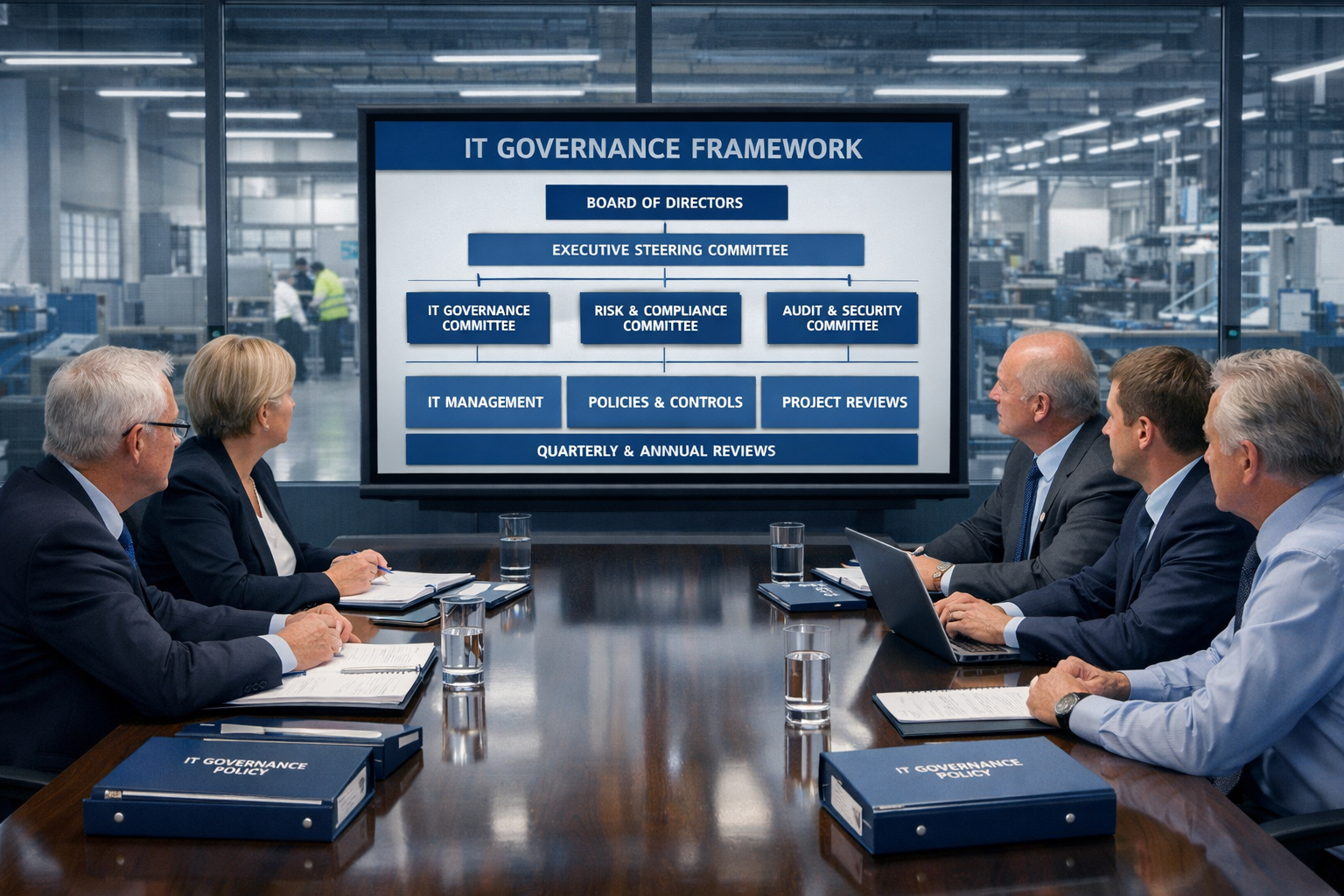
Level 1: Board oversight. The board reviews IT performance quarterly using a one-page dashboard. A named board member (or the fractional IT director) is responsible for presenting technology matters to the board, including cybersecurity risk, major project updates, vendor performance, and investment recommendations. The board approves the annual IT budget and any unplanned expenditure above a defined threshold.
Level 2: IT steering group. A monthly meeting of the MD (or operations director), the IT lead (internal or fractional), and key department heads. This group prioritises IT initiatives, reviews project progress, manages vendor relationships, and ensures IT activity aligns with production and business priorities. For a manufacturer, this group should explicitly include someone who represents the OT / production environment, not just office IT.
Level 3: Operational policies. Documented policies covering: acceptable use of IT systems, access control and password management, change management for production-critical systems, backup and disaster recovery procedures, incident response, and vendor onboarding and offboarding. These do not need to be lengthy — a clear, one-page policy for each area is far more effective than a 30-page document nobody reads.
Level 4: Review and improvement cycle. Annual review of the entire IT governance framework, including a vendor contract audit, cybersecurity posture assessment, asset and licence review, and evaluation of whether the IT strategy remains aligned with business objectives. This annual cycle ensures governance stays relevant as the business and threat landscape evolve.
How to Implement IT Governance Without Disrupting Production
The biggest barrier to implementing an IT governance framework manufacturing SMEs UK leaders face is not complexity — it is time. Manufacturing businesses are busy. The MD is managing customers, production, and cash flow. Nobody has spare capacity to build a governance framework from scratch. Here is how to do it practically:
Month 1: Build the foundation. Create the IT asset register and vendor register. These are the two most immediately valuable governance artefacts. You cannot govern what you cannot see, and most manufacturers discover during this step that they have vendors they forgot about, licences nobody uses, and OT assets nobody has documented.
Month 2: Establish the steering group. Set up the monthly IT steering group meeting with a standing agenda: project updates, vendor issues, cybersecurity matters, and upcoming decisions. Keep it to 60 minutes. The discipline of regular, structured IT discussion transforms how decisions are made — from reactive and informal to deliberate and informed.
Month 3: Draft core policies. Write the essential operational policies — access control, change management, backup and disaster recovery, incident response. Keep them short, practical, and specific to your manufacturing environment. Ensure they cover both IT and OT systems.
Month 4 onwards: Board reporting and continuous improvement. Begin quarterly board reporting using the one-page dashboard. Run the first annual vendor audit. Assess cybersecurity posture against the Cyber Governance Code of Practice requirements. Refine and improve based on what you learn.
The Role of a Fractional IT Director in Establishing Governance
IT governance requires someone with the authority to establish it, the expertise to design it, and the credibility to maintain it. In most manufacturing SMEs, this person does not exist internally. The MSP manages operational IT but has no governance mandate. The office manager handles IT procurement but lacks the strategic authority to challenge vendors or prioritise investments. The MD understands the business but does not have the technical knowledge to assess IT risk.
A fractional IT director fills precisely this gap. They design the governance framework, chair the steering group, present to the board, manage vendor relationships, and ensure cybersecurity risk is properly owned and reported. Because they work across multiple manufacturers, they bring governance best practices from other businesses — knowing what works, what creates unnecessary bureaucracy, and what level of structure delivers the right balance between control and agility for a production environment.
Frequently Asked Questions
What is IT governance for a manufacturing SME?
IT governance for a manufacturing SME is the set of roles, policies, and processes that ensure technology decisions are made deliberately, risks are managed proactively, and IT investment aligns with business objectives. It does not require enterprise-level frameworks like COBIT or ITIL in full. A practical governance framework for a manufacturer includes clear decision-making authority, vendor management, cybersecurity risk oversight, asset management, and board-level reporting.
Do small manufacturers need IT governance?
Yes. Any manufacturer that depends on IT and OT systems for production — which today means virtually every manufacturer — needs governance proportionate to their size and risk. Without it, IT costs grow unmanaged, cybersecurity gaps go unaddressed, and technology decisions are made reactively rather than strategically. The governance framework should be lightweight and practical, not bureaucratic, but the core elements of accountability, oversight, and reporting are essential regardless of size.
How long does it take to implement IT governance in a manufacturing business?
A practical IT governance framework for a mid-market manufacturer can be established in three to four months, covering asset and vendor registers, a monthly steering group, core operational policies, and quarterly board reporting. Full maturity — including annual review cycles, cybersecurity posture assessments, and continuous improvement — develops over 12 to 18 months. The key is starting with the highest-value elements and building from there.
What is the UK Cyber Governance Code of Practice?
Published by the UK Government in April 2025, the Cyber Governance Code of Practice is a voluntary framework designed to help board directors govern cybersecurity risk. It calls for board-level ownership of cyber risk, regular reporting, formal incident response planning, and risk-proportionate security measures. While currently voluntary, it signals the direction of regulatory expectations and is likely to become the baseline standard against which cybersecurity governance is assessed. Manufacturers should align their IT governance frameworks with the Code’s five key actions.
Take the Next Step
Bailey & Associates helps UK manufacturers establish practical IT governance frameworks that bring structure to technology decisions without creating bureaucracy. From steering group facilitation and board reporting to vendor audits and cybersecurity governance, our virtual IT director services provide the accountability and oversight your IT environment needs. Fixed monthly pricing from 2,000 pounds per month, no long-term tie-ins, and over 15 years of manufacturing IT experience. Book a free discovery call today.
