
Predictive maintenance initiatives fail in 60% of manufacturing operations due to fundamental data quality issues. Poor-quality data causes systems to generate false alarms and miss actual failure predictions, undermining the entire reliability strategy.
The accuracy of predictive maintenance depends on three critical factors: relevance, quantity, and quality of collected data. Without these elements working together, your manufacturing digital transformation investment delivers inconsistent results and wastes resources on unnecessary maintenance activities.
The Hidden Data Quality Crisis in Manufacturing
Manufacturing operations generate massive amounts of data daily. Sensors monitor vibration patterns, temperature fluctuations, pressure readings, and power consumption across production lines. Historical maintenance logs document repair patterns and equipment performance over time.
This data appears comprehensive on the surface. The reality reveals significant gaps. Inconsistent sensor calibration produces unreliable readings. Missing historical records create incomplete baselines. Poor data integration prevents systems from correlating patterns across different equipment types.

Equipment sensors frequently malfunction or drift out of calibration without immediate detection. Temperature sensors may read consistently high or low due to environmental factors. Vibration monitors can miss critical frequency ranges if positioned incorrectly. These issues compound over time, creating cascading errors throughout predictive models.
Data silos represent another major challenge. Production data exists in one system while maintenance records reside in another. Quality control measurements stay isolated from equipment performance metrics. IT-OT integration planning addresses these disconnects, but many manufacturers struggle with implementation.
Why Poor Data Destroys Predictive Maintenance ROI
False positives waste maintenance resources and disrupt production schedules. Systems trigger alerts for equipment that operates normally, forcing technicians to investigate non-existent problems. These unnecessary interventions cost time and money while reducing confidence in predictive capabilities.
Missed failures prove even more costly. Equipment breaks down unexpectedly when predictive systems fail to identify warning signs in corrupted or incomplete data. Unplanned downtime can cost manufacturers $50,000 per hour or more, depending on production complexity.
Predictive models require clean, consistent data to identify meaningful patterns. Garbage data produces garbage predictions. Models trained on poor-quality information develop incorrect baselines and fail to recognize genuine failure indicators.
Historical maintenance data plays a crucial role in establishing performance benchmarks. Incomplete records prevent systems from understanding normal equipment behavior patterns. Missing failure documentation eliminates learning opportunities that improve future predictions.
Immediate Data Quality Assessment Steps
Start with a comprehensive data audit across all maintenance-related systems. Extract data from your Computerized Maintenance Management System covering the past 24 months. Review sensor installation dates, calibration records, and replacement schedules to identify potential accuracy issues.
Examine data completeness by calculating the percentage of missing values across critical metrics. Temperature readings should capture data points every few minutes during operation. Vibration measurements need consistent sampling rates to detect frequency changes. Pressure sensors require regular intervals to track gradual changes over time.

Validate sensor accuracy through manual verification. Compare automated readings against handheld instruments for temperature, pressure, and vibration measurements. Document discrepancies exceeding acceptable tolerances and schedule immediate calibration or replacement.
Review data storage and transmission protocols. Confirm that sensor data reaches central systems without corruption or loss. Network connectivity issues can cause gaps in data streams that compromise predictive accuracy.
Assess data integration capabilities between operational technology and information technology systems. Determine whether production data flows seamlessly into maintenance platforms or requires manual intervention.
Rapid Data Quality Improvement Strategies
Implement automated data validation rules that catch errors before analysis begins. Configure systems to flag temperature readings outside normal operating ranges. Set alerts for vibration measurements that spike unexpectedly or drop to zero without scheduled shutdowns.
Establish sensor maintenance schedules based on manufacturer recommendations and operating conditions. Clean temperature sensors monthly to prevent dust accumulation that affects accuracy. Recalibrate pressure instruments quarterly or after significant maintenance activities. Replace vibration sensors according to specified service intervals.
Deploy redundant sensors for critical equipment to provide backup data sources when primary instruments fail. Install multiple temperature monitors on high-value assets to enable cross-validation of readings. Add secondary vibration sensors at different positions to capture comprehensive equipment behavior.
Create data governance protocols that ensure consistent collection and storage practices. Define standard naming conventions for equipment tags and measurement types. Establish data retention policies that preserve historical information while managing storage costs effectively.

Integrate multiple data sources to create comprehensive equipment profiles. Combine real-time sensor measurements with historical maintenance records, operational parameters, and environmental conditions. This holistic approach improves prediction accuracy by providing context for unusual readings.
IT-OT Integration Planning for Predictive Success
Manufacturing digital transformation requires seamless connection between operational technology on the factory floor and information technology in corporate systems. Plan integration projects that preserve operational security while enabling data sharing for predictive maintenance applications.
Evaluate existing network infrastructure to support increased data traffic from IoT devices and sensors. Upgrade bandwidth capacity to handle continuous data streams without impacting production operations. Install edge computing devices to process data locally and reduce network load.
Design secure data transmission protocols that protect manufacturing operations from cyber threats. Implement encryption for sensor data moving between factory floor devices and central systems. Configure firewalls to allow necessary data flow while blocking unauthorized access attempts.
Establish real-time data synchronization between maintenance management systems and production planning software. Enable automatic updates when predictive systems identify potential equipment issues that could affect production schedules.
Create standardized data formats that enable interoperability between different vendor systems. Define common measurement units, timestamp formats, and equipment identification schemes across all connected devices.
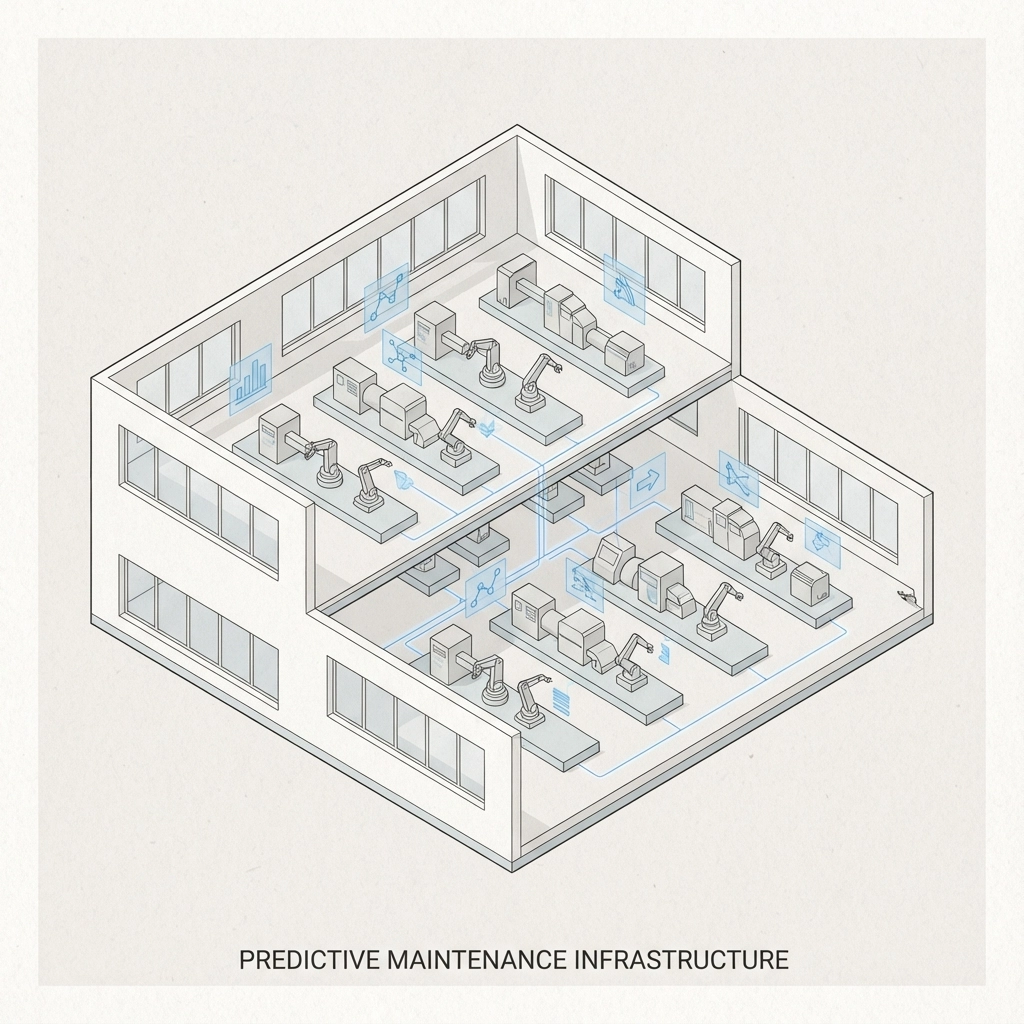
Building Reliable Predictive Maintenance Infrastructure
Deploy condition monitoring systems that collect multiple data types from each critical asset. Combine vibration analysis with thermal imaging and oil analysis for rotating equipment. Monitor electrical signatures alongside mechanical measurements for motor-driven systems.
Configure automated reporting that highlights data quality issues requiring attention. Generate weekly reports showing sensor availability, calibration status, and data completeness metrics. Schedule monthly reviews of predictive model performance and accuracy trends.
Establish baseline performance profiles for all monitored equipment during normal operating conditions. Document typical vibration signatures, temperature ranges, and pressure patterns for different production scenarios. Update baselines when equipment undergoes major maintenance or operational changes.
Train maintenance teams to interpret predictive data and respond appropriately to system alerts. Provide guidance on distinguishing between genuine failure indicators and data quality issues. Develop escalation procedures for addressing urgent predictions that require immediate action.
Implement feedback mechanisms that improve predictive accuracy over time. Record actual failure modes when equipment breaks down and compare against system predictions. Use this information to refine models and eliminate recurring false positives.
Measuring and Sustaining Data Quality Improvements
Track key performance indicators that demonstrate predictive maintenance effectiveness. Monitor the ratio of true positives to false alarms for each equipment type. Calculate mean time between failures before and after implementing predictive strategies.
Establish data quality metrics that provide early warning of system degradation. Measure sensor availability percentages across all monitored assets. Track data completeness rates for critical measurements used in predictive models.
Schedule regular data quality reviews that identify emerging issues before they compromise predictive accuracy. Conduct quarterly assessments of sensor performance and calibration drift. Review integration effectiveness between IT and OT systems annually.
Document lessons learned from predictive maintenance implementation to guide future improvements. Record successful strategies for addressing specific data quality challenges. Share best practices across maintenance teams and production facilities.
Organizations implementing comprehensive data quality improvements typically achieve 10-20% increases in Overall Equipment Effectiveness within the first year. Unplanned downtime decreases significantly when predictive systems operate with reliable, high-quality data inputs.
Ready to transform your manufacturing digital transformation approach? Contact our team to discuss IT-OT integration planning strategies that deliver reliable predictive maintenance results for your operation.
