
PLM ERP integration manufacturing IT leaders must address is one of the most valuable — and most commonly botched — technology projects in a production environment. When your Product Lifecycle Management system and your Enterprise Resource Planning system operate as separate silos, engineering designs get re-keyed into production, bill of materials mismatches cause procurement errors, and engineering change orders take days to reach the shop floor. Research shows that automating the PLM-ERP data transfer delivers an 89% improvement in data accuracy and a 75% reduction in manual re-keying effort. Yet most mid-market manufacturers still transfer this data manually — with all the errors, delays, and cost that implies.
Last updated: 16 April 2026
What PLM ERP Integration Means in a Manufacturing Context
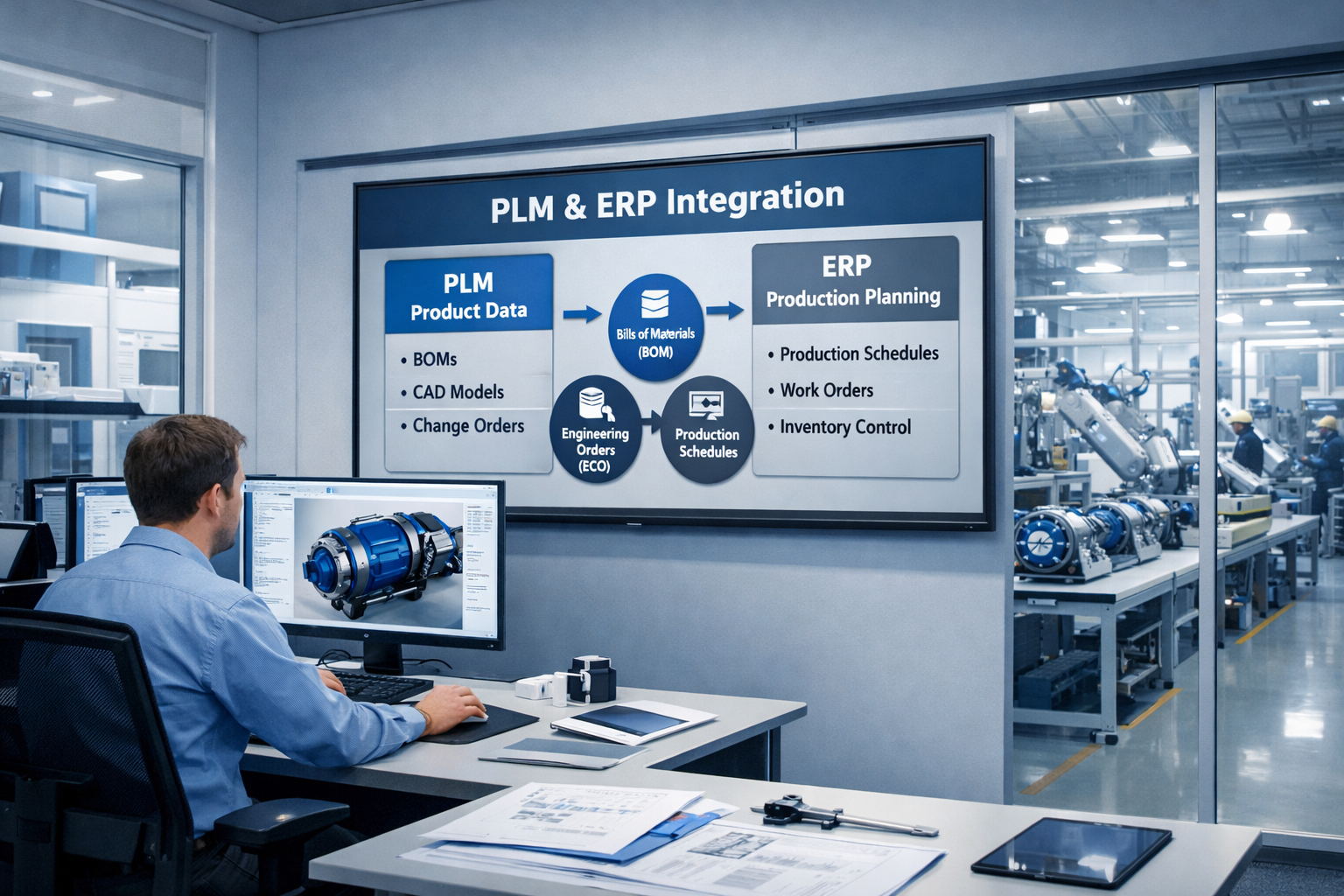
Product Lifecycle Management (PLM) and Enterprise Resource Planning (ERP) serve different but interconnected purposes in manufacturing. PLM manages the product itself — design data, CAD models, engineering bills of materials (eBOMs), revision histories, and engineering change processes. It is the engineering team’s system. ERP manages the business of making the product — manufacturing bills of materials (mBOMs), production scheduling, procurement, inventory, cost accounting, and delivery. It is the system that operations, finance, and supply chain teams depend on.
The problem arises at the handover point. When engineering approves a product design in PLM, that information must flow accurately into ERP so that production can plan, procure, and build the product. This includes the bill of materials, component specifications, approved suppliers, revision status, and any engineering change notices. Without integration, this transfer happens manually — an engineer exports a spreadsheet from PLM, someone in planning re-enters it into ERP, and errors accumulate at every step.
According to TriMech Enterprise, proper PLM-ERP integration creates a seamless flow of information that eliminates data silos, enables real-time visibility, and fosters communication between product development and the shop floor. Aberdeen Group research found that 59% of manufacturers have already integrated PLM with ERP, and that companies with this integration in place consistently outperform those without it on time-to-market, product quality, and cost control metrics.
Why PLM ERP Integration Matters for UK Manufacturers
The business case for PLM ERP integration manufacturing IT investment becomes clear when you quantify the cost of disconnected systems:
- BOM accuracy: Industry research shows a 75% reduction in costs associated with bill of materials errors when PLM and ERP are integrated. Incorrect BOMs cause a cascade effect: wrong parts procured, quality issues on the line, production delays, wasted materials, and ultimately customer dissatisfaction.
- Time-to-market acceleration: When a product design is approved in PLM, integrated systems channel production and delivery operations into ERP instantly rather than waiting for manual data transfer. This can reduce new product introduction cycles by 20 to 30%.
- Engineering change control: In a disconnected environment, engineering change orders can take days to propagate from design to the shop floor. With integration, changes flow automatically, ensuring production always works from the current revision. This is critical in regulated sectors like aerospace (AS9100) and automotive (IATF 16949) where building to an obsolete revision creates compliance exposure.
- Inventory optimisation: When engineers can see real-time inventory data from ERP while designing in PLM, they can reuse existing components rather than specifying new ones — reducing inventory costs by up to 15% and procurement complexity.
- Reduced manual effort: A 75% reduction in manual re-keying labour means fewer data entry staff, fewer errors to investigate, and more time for value-adding engineering work.
- Complete traceability: For manufacturers in regulated industries, the ability to trace a finished product back through production (ERP), through manufacturing planning (mBOM), to the original engineering design (eBOM in PLM) is a compliance requirement that is extremely difficult to achieve without system integration.
The Key Data Flows in PLM-ERP Integration
Successful PLM ERP integration manufacturing IT teams must plan centres on four critical data flows between the two systems:
Engineering BOM to Manufacturing BOM. This is the most important integration point. The engineering BOM in PLM defines what the product is made of from a design perspective. The manufacturing BOM in ERP defines how the product is made from a production perspective — including work centres, routing operations, tooling, and procurement sources. Integration must translate between these two views, mapping engineering components to production-ready items, adding manufacturing-specific data, and handling cases where one eBOM generates multiple mBOMs for different production sites.
Engineering change orders. When engineering modifies a design — replacing a component, changing a specification, or updating a tolerance — the change must flow from PLM into ERP with full audit trail. The integration must handle effectivity dates (when the change takes effect), track which production batches are affected, and ensure procurement adjusts orders to match the new specification. In our experience, poor engineering change management is the single most common source of production errors in manufacturers with disconnected PLM and ERP.
Item master synchronisation. New parts created in PLM must be automatically created in ERP with the correct attributes — description, unit of measure, material type, weight, supplier references, and compliance classifications. Manual item creation in ERP is slow, error-prone, and creates version conflicts when the same part exists with different attributes in each system.
Status and lifecycle synchronisation. When a product moves from prototype to production-ready in PLM, ERP must know. When a component is marked obsolete, both systems must reflect this simultaneously. Lifecycle mismatches between PLM and ERP create situations where production builds products using components that engineering has already replaced — a problem that is both expensive and, in regulated industries, dangerous.
Common Mistakes Manufacturers Make with PLM-ERP Integration
The integration itself is a technical project, but the mistakes that cause it to fail are almost always strategic:
Treating it as a purely IT project. PLM-ERP integration fundamentally changes how engineering, production planning, procurement, and quality teams work together. If these stakeholders are not involved from the outset, the integration will be technically complete but operationally useless — designed around data models that do not match how the business actually works.
Underestimating BOM complexity. The engineering BOM and manufacturing BOM are rarely identical. Engineers think in terms of assemblies and sub-assemblies; production thinks in terms of work orders and routing operations. Phantom assemblies, alternate components, effectivity dates, and site-specific variations all add complexity that a simple “copy BOM from PLM to ERP” approach cannot handle. Each of these differences must be mapped and validated before the integration goes live.
Ignoring data quality in source systems. Integration amplifies data problems. If your PLM contains duplicate parts, inconsistent naming conventions, or incomplete component records, those problems will flow straight into ERP and multiply. Data cleansing in both systems before integration is not optional — it is a prerequisite.
No ongoing governance. Integration is not a one-time project. As products evolve, new components are added, and production processes change, the integration rules must be maintained, updated, and monitored. Without a defined governance process, integration quality degrades over time — and the manual workarounds return.
A Practical Approach to PLM-ERP Integration for Manufacturers
Rather than a monolithic integration project, the most successful approach is phased and focused:
Phase 1 — Map and cleanse (months 1-2). Document the current data flow between engineering and production. Identify every point where data is manually transferred, re-keyed, or transformed. Cleanse item master data in both PLM and ERP to eliminate duplicates and standardise attributes. Define the integration rules for BOM translation, change order propagation, and lifecycle synchronisation.
Phase 2 — Connect the core (months 3-5). Implement the primary integration: eBOM to mBOM transfer and engineering change order flow. Start with a single product family to validate the integration rules before expanding. Use middleware or native connectors depending on your PLM and ERP platforms — leading combinations include Siemens Teamcenter with SAP, PTC Windchill with Epicor, and Autodesk Fusion with Dynamics 365.
Phase 3 — Extend and optimise (months 6-9). Expand integration to cover all product families, item master synchronisation, and bidirectional status updates. Implement monitoring dashboards that track integration health, flag synchronisation failures, and measure data quality metrics. Ensure the Make UK digital adoption goals align with your integration roadmap.
Each phase requires IT leadership that understands both engineering data (PLM) and production data (ERP) — and can coordinate the cross-functional teams involved. This is exactly the type of integration challenge where a fractional IT director with manufacturing experience adds direct value.
Frequently Asked Questions
What is the difference between an eBOM and an mBOM?
An engineering BOM (eBOM) defines what a product is made of from a design perspective — assemblies, sub-assemblies, and components as defined by engineering. A manufacturing BOM (mBOM) defines how the product is made from a production perspective — adding work centres, routing operations, tooling, procurement sources, and site-specific variations. The eBOM is managed in PLM; the mBOM is managed in ERP. PLM-ERP integration must translate between these two views, which are rarely identical.
How long does PLM-ERP integration take for a mid-market manufacturer?
A focused PLM-ERP integration covering BOM transfer and engineering change order flow typically takes three to five months for the initial product family. Extending to full integration across all products, item master synchronisation, and lifecycle management adds another three to six months. The timeline depends heavily on data quality in the source systems — manufacturers with clean, well-structured PLM and ERP data move significantly faster than those with years of accumulated data inconsistencies.
Can PLM and ERP integration work with legacy systems?
Yes, though it requires more middleware and custom development. Modern PLM and ERP platforms (Siemens Teamcenter, PTC Windchill, SAP, Epicor, Dynamics 365) offer native connectors or certified integration platforms. Legacy systems often lack APIs, requiring file-based integration or custom middleware that translates between older data formats. The cost and complexity are higher, but the business case for integration is often strongest precisely where legacy systems create the most manual workarounds.
Do I need PLM-ERP integration if I only have a small engineering team?
If your engineering team creates or modifies product designs that production must then build, you benefit from integration regardless of team size. The question is not the number of engineers — it is the volume and complexity of the data transfer between design and production. Even a five-person engineering team creating 50 engineering change orders per year can cause significant production errors if those changes are communicated via email and spreadsheet rather than through integrated systems.
Take the Next Step
Bailey & Associates helps UK manufacturers plan and execute PLM-ERP integration projects that connect engineering to production without disrupting either. From initial data mapping and cleansing through to integration design, vendor coordination, and ongoing governance, our virtual IT director services provide the strategic oversight to ensure your integration delivers measurable results. Fixed monthly pricing from 2,000 pounds per month, no long-term tie-ins, and over 15 years of manufacturing IT experience. Book a free discovery call today.
Related Service: ERP & Digital Transformation Strategy — Learn how Bailey Associates can help your manufacturing business.
