
The MES vs ERP manufacturing UK debate is one of the most common questions manufacturers ask when planning technology investment. The short answer: most manufacturers should get their ERP right first, then add a Manufacturing Execution System when shop floor visibility and real-time production control become critical for growth, quality, or compliance. But the longer answer depends on where your biggest problems actually sit — in the office or on the factory floor.
Last updated: 3 April 2026
What Is the Difference Between MES and ERP in Manufacturing?
ERP (Enterprise Resource Planning) and MES (Manufacturing Execution System) serve fundamentally different purposes, even though they both involve production data. Understanding this distinction is essential before making any investment decision.
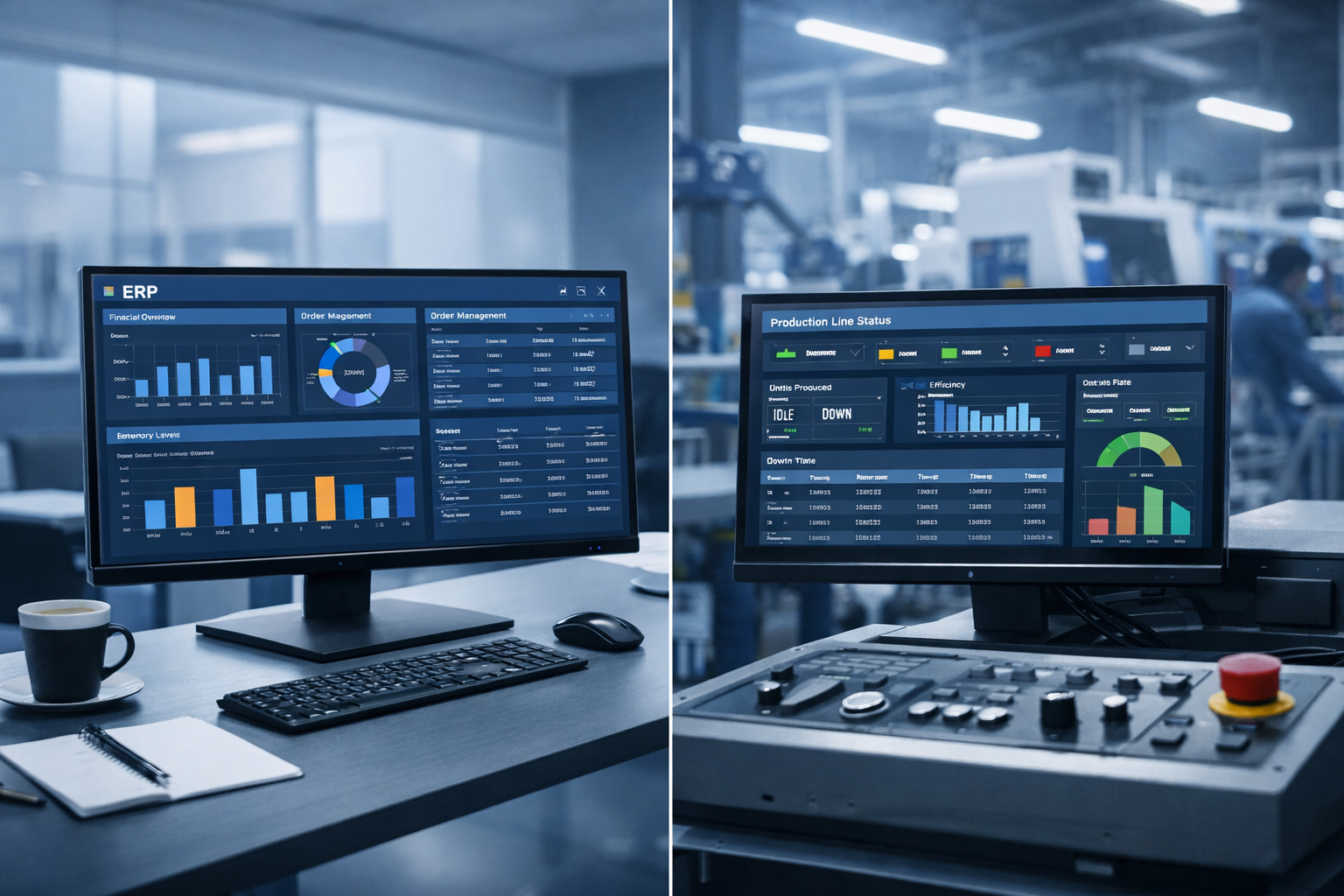
An ERP system is the business brain of your manufacturing operation. It manages planning, finance, procurement, inventory, sales, and cost accounting across the entire company. When a customer places an order, ERP checks stock levels, calculates material requirements, generates purchase orders, schedules production at a planning level, and tracks the financial impact through to invoicing. ERP answers business-level questions: What do we need to make? When does it need to ship? How much will it cost? Do we have the materials?
A MES is the shop floor brain. It manages real-time execution once work reaches the factory floor. MES tracks which operator is working on which job, what stage each part has reached, how long operations are taking, machine status, scrap rates, and whether jobs are running to plan. MES answers operational questions: Is this machine running? Did this operator complete that step correctly? Which batch of material went into this product? Why is this job running late?
As Rockwell Automation explains, an MES bridges the gap between the business and manufacturing worlds — between factory leadership, engineering, line of business, and supply chain. ERP plans the work; MES executes it.
Why the MES vs ERP Question Matters for UK Manufacturers
Getting this decision right matters because both systems represent significant investment — in software, implementation, training, and organisational change. Choosing the wrong priority wastes money and, more importantly, time. Here is what each system delivers when implemented correctly:
- ERP delivers: Accurate financial reporting across the business, integrated procurement and inventory management, production planning based on demand and capacity, customer order tracking from quote to invoice, regulatory and compliance documentation, and a single source of truth for business data
- MES delivers: Real-time visibility of job progress on every machine and workstation, operator performance and labour tracking, quality control at each production step, complete batch and serial traceability from raw materials to finished goods, machine utilisation and OEE (Overall Equipment Effectiveness) data, and automated data capture that eliminates manual shop floor paperwork
- Together they deliver: End-to-end visibility from customer order through production to dispatch, accurate work-in-progress costing based on real data rather than estimates, production schedules grounded in actual shop floor capacity, and the ability to respond to disruptions in real time rather than discovering problems after the fact
According to Make UK’s Making it Smarter report, while 70% of UK manufacturers are investing in digital tools, only 10% operate fully digital factories. The gap between planning and execution — exactly the gap that MES fills — remains one of the biggest inefficiencies in UK manufacturing.
When to Invest in ERP First
For most mid-market UK manufacturers weighing the MES vs ERP manufacturing UK decision, ERP should come first. If your business is still running on spreadsheets, disconnected systems, or an ageing ERP that no longer meets your needs, fixing the business foundation takes priority. You need ERP first if:
Your departments are disconnected. Sales does not know what production has scheduled. Purchasing does not know what is already in stock. Finance cannot get accurate job costs without manually chasing data from three different systems. An ERP system connects these functions into a single platform.
You cannot accurately cost your products. If you are estimating rather than calculating actual production costs — materials consumed, labour hours, machine time, scrap rates — your pricing decisions are based on guesswork. ERP gives you the financial foundation that every other system builds on.
Your planning is reactive. If production scheduling means the MD walking the shop floor each morning to decide what runs next, or if late deliveries are a regular occurrence because nobody can see the full picture, you need planning capability before execution visibility.
A typical ERP implementation for a mid-market manufacturer takes 12 to 18 months and requires careful planning around production schedules to avoid disruption. This is exactly the kind of project that benefits from strategic IT oversight — someone who has managed ERP implementations in manufacturing environments and can hold the vendor accountable.
When to Invest in MES First (or Alongside ERP)
There are scenarios where MES should be the priority, or where it makes sense to implement MES alongside your ERP:
Your ERP is working but your shop floor is a black hole. If your business systems are reasonably functional but you have no visibility of what is actually happening in production — jobs disappear between release and completion, you cannot tell a customer when their order will be ready, and scrap only shows up when someone counts finished goods — MES addresses the gap your ERP cannot fill.
You have regulatory traceability requirements. Food and drink manufacturers need batch traceability for BRCGS compliance. Aerospace manufacturers need full component genealogy for AS9100. Pharmaceutical manufacturers need GxP-compliant production records. If regulatory traceability is your primary driver, a MES delivers this more effectively than trying to force it through an ERP system that was not designed for it.
You need to improve OEE. If production efficiency is your main challenge — machines sitting idle, excessive changeover times, high scrap rates — MES captures the real-time data you need to identify and eliminate waste. ERP can tell you what should have happened; MES tells you what actually happened and why.
Specialist MES platforms can often be deployed in under 90 days with a much narrower scope than a full ERP implementation, making them a practical option for manufacturers who need quick wins on the shop floor.
How MES and ERP Work Together in a Manufacturing Environment
As the MES vs ERP manufacturing UK discussion shows, the question is ultimately not either/or — it is about sequencing and integration. In a well-designed manufacturing technology stack, ERP and MES work together through bidirectional data flow:
ERP sends down: production orders released for manufacturing, bills of material and routing information, material master data, production schedules, and engineering change notifications. This is the plan.
MES sends back up: actual quantities produced, scrapped, and reworked, actual labour hours consumed, real material consumption versus planned, quality inspection results, and machine performance data. This is reality.
When these two systems are properly integrated, planners can create schedules based on actual shop floor conditions rather than assumptions. Finance gets accurate work-in-progress valuations based on real production data. Quality teams can trace any product back through every production step to raw material receipt. And the board gets reporting that shows both the business picture and the operational picture in a single view.
The The Manufacturer reports that 86% of manufacturers believe digital technologies are key to their future competitiveness, yet only 45% have fully implemented such solutions. Getting MES and ERP working together is one of the highest-value integration projects a manufacturer can undertake.
Frequently Asked Questions
Can ERP replace MES in manufacturing?
For simple manufacturing operations with short production cycles and minimal traceability requirements, a capable ERP system may provide sufficient shop floor functionality. However, for manufacturers who need real-time machine integration, detailed batch or serial traceability, step-by-step operator work instructions, in-process quality control, or regulatory compliance documentation, a purpose-built MES will significantly outperform an ERP’s built-in manufacturing module.
How much does a MES cost for a UK manufacturer?
MES costs vary significantly depending on scope. A focused MES deployment covering a single production area might cost between 50,000 and 150,000 pounds including software, integration, and implementation. A full factory deployment with machine integration and ERP connectivity typically ranges from 150,000 to 500,000 pounds. Cloud-based MES solutions can reduce upfront costs by 30 to 40% compared to on-premise installations.
Should a small manufacturer invest in MES?
Small manufacturers with fewer than 50 employees often benefit more from getting their ERP right first. However, if your primary challenge is shop floor visibility — not knowing where jobs are, which machines are running, or why delivery dates keep slipping — a focused MES deployment can deliver rapid return on investment. Cloud-based MES platforms have made the technology accessible to smaller manufacturers at lower price points than traditional enterprise solutions.
How long does it take to implement MES alongside an existing ERP?
A focused MES implementation alongside an existing ERP typically takes three to six months, compared to 12 to 18 months for a full ERP replacement. The shorter timeline is possible because MES targets shop floor execution rather than company-wide business processes. Integration with ERP adds complexity but can be managed in phases, starting with basic work order synchronisation and expanding to full bidirectional data flow over time.
Take the Next Step
Bailey & Associates helps UK manufacturers navigate the MES and ERP decision with independent, vendor-neutral advice. Whether you are selecting a new ERP, evaluating MES options, or planning the integration between the two, our virtual IT director services provide the strategic oversight to ensure you invest in the right system at the right time. Fixed monthly pricing from 2,000 pounds per month, no long-term tie-ins, and over 15 years of manufacturing IT experience. Book a free discovery call today.
Related Service: ERP & Digital Transformation Strategy — Learn how Bailey Associates can help your manufacturing business.
