
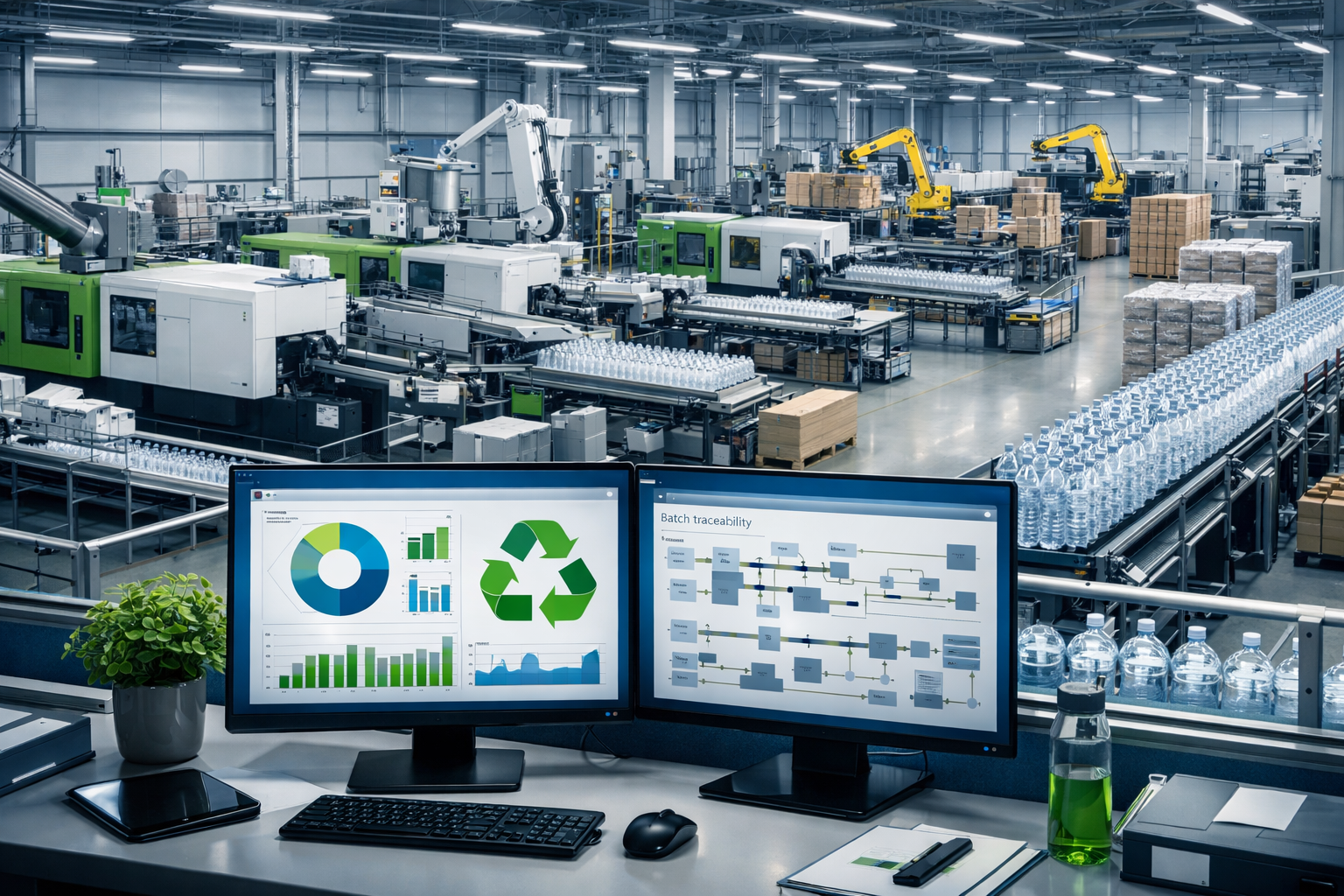
An effective IT strategy plastics packaging manufacturers UK programme has to do something most generic manufacturing IT strategies skip: deliver real-time, auditable evidence of recycled-content percentages, batch traceability and packaging data at SKU level, while still running 24/7 injection moulding and extrusion lines. With the UK Plastic Packaging Tax now sitting at £217.85 per tonne and Extended Producer Responsibility shifting the full cost of packaging waste onto producers, sustainability reporting is no longer a side project — it is part of the core IT roadmap.
Last updated: 29 April 2026
What an IT strategy plastics packaging manufacturers UK plan must cover
The UK plastics industry is huge and structurally important. According to the British Plastics Federation (BPF), the sector generates over £32.8 billion in annual sales, employs around 160,000 people, and produces approximately 1.6 million tonnes of plastics raw materials each year. Packaging is the largest sub-sector by volume, with the UK packaging manufacturing industry alone turning over around £11 billion and employing more than 70,000 people.
Sitting on top of that production base are three regulatory tracks every UK packaging maker has to satisfy: the Plastic Packaging Tax administered by HMRC, the Extended Producer Responsibility (EPR) reporting regime introduced in 2025, and customer-specific compliance from major retailers and FMCG brands. The IT strategy plastics packaging manufacturers UK roadmap must therefore cover seven domains:
- Process manufacturing ERP with regrind, scrap and tool management built in.
- Real-time shop-floor data capture from injection-moulding, extrusion, blow-moulding and converting lines.
- Lot and batch traceability across virgin material, regrind, in-process and finished goods.
- Recycled-content tracking at component and SKU level for Plastic Packaging Tax reporting.
- EPR data capture, Nation of Sale reporting and Packaging Recovery Note (PRN) flows.
- OT cybersecurity for connected machines, robots and warehouse automation.
- EDI and B2B integration with retailer and FMCG portals.
Treating any of these as a side project is the most common failure mode. The job of an IT strategy plastics packaging manufacturers UK plan is to bring them onto a single roadmap with one technology leader accountable for the whole.
The Plastic Packaging Tax: an IT problem in disguise
The Plastic Packaging Tax came into force on 1 April 2022 and is now charged at £217.85 per tonne of plastic packaging that contains less than 30% recycled content. Manufacturers and importers cross into the obligated population once they handle 10 tonnes or more in any rolling 12-month period, must register with HMRC within 30 days of crossing that threshold, and must submit quarterly returns separating virgin plastic, recycled plastic over 30%, and exempt materials.
For a UK packaging manufacturer, those are not finance department requirements; they are IT data requirements. The strategy must therefore deliver:
- Material master data with recycled-content percentage, source and supplier declaration linked to every component.
- Real-time tracking of regrind production and consumption, with auditable allocation back to specific batches.
- BOM-level recycled-content roll-up for finished SKUs, with supporting evidence.
- Quarterly reporting workflows that pre-populate HMRC submissions, not manual spreadsheet drag.
- Document management for supplier declarations, technical specifications and chain-of-custody evidence.
- Audit-ready records that survive an HMRC inspection three or four years later.
Without these capabilities baked into the ERP and shop-floor data layer, manufacturers either over-pay tax (because they cannot prove recycled content) or under-pay (and expose themselves to penalties). The right IT strategy avoids both.
EPR reporting and the move to mandatory data capture
Extended Producer Responsibility for packaging, summarised by the UK government’s EPR guidance, requires UK organisations that supply or import packaging to report packaging data and pay fees based on packaging weight, material and recyclability. Large producers (turnover above £2M, more than 50 tonnes of packaging) report at least twice a year, pay Local Authority Waste Management Fees, and from 2026 must also submit Nation of Sale data showing where packaging ends up across the four UK nations.
The data demands behind these reports are deep. Packaging type, weight by material, recyclability classification, household versus business use, and customer-channel attribution all need to be captured at production, not reverse-engineered later. An IT strategy plastics packaging manufacturers UK plan should turn EPR into a workflow inside the ERP, not a quarterly fire drill in finance.
Sector-specific shop-floor and ERP capabilities
Plastics and packaging production runs differently from discrete manufacturing. The IT estate has to reflect that. Sensible priorities for a typical UK plastics or packaging manufacturer:
- Process manufacturing ERP. BOMs that handle multi-component recipes, regrind, colour-masterbatch ratios, and scrap. Job-shop ERPs converted to plastics rarely cover this.
- Tool and mould management. Track tool lifecycles, scheduled maintenance, cycle counts and ownership (some moulds belong to customers, not the manufacturer).
- Real-time machine integration. Inject and extrusion machines from KraussMaffei, Engel, Husky, Nissei and Arburg increasingly support OPC UA and EUROMAP 77/79. Use those standards rather than bespoke connectors.
- OEE and downtime measurement. The combination of fast cycle times and high-volume production makes even small OEE gains worth six-figure sums.
- Lot traceability. From inbound resin through regrind, in-process WIP, finished goods and pallet-level despatch. Essential for food contact and pharmaceutical packaging.
- Quality and BRCGS. For food, drink and pharma packaging, BRCGS Packaging Materials evidence has to be electronic, complete and audit-ready.
- EDI and customer portals. Tesco, Sainsbury’s, Asda, Morrisons, Aldi, Lidl, Unilever, Reckitt and others all run their own EDI, label and forecast systems.
The combination of high cycle volumes, regulatory complexity and customer-specific compliance is what makes the IT strategy plastics packaging manufacturers UK challenge distinct.
Cyber, supply chain and recent UK pressures
Two pressures should be visible in every UK plastics IT strategy in 2026. First, supply-chain volatility: a March 2026 BPF survey found 58% of member firms reporting raw-material shortages and step-change cost rises, the worst conditions in a generation. IT systems that cannot model alternative suppliers, recycled-content blends and customer-specific substitutions force operations to absorb the impact manually.
Second, cyber. Connected injection moulding cells, automated palletising lines and warehouse robotics are now genuine attack surfaces. The IT strategy should include Cyber Essentials Plus as a baseline, OT segmentation between machine networks and corporate IT, controlled remote access for vendor support, and incident response plans tested against ransomware on a 24/7 line. NIS2 flow-down from EU customers and growing UK regulation make these table stakes.
How to choose a partner for a plastics and packaging IT strategy
Generic fractional CIO firms rarely understand process manufacturing, regrind accounting or BRCGS audits. When choosing a partner for an IT strategy plastics packaging manufacturers UK programme, look for:
- Real plastics and packaging experience, not just “discrete manufacturing”.
- Working knowledge of Plastic Packaging Tax tracking, EPR reporting and PRN/PERN flows.
- Process ERP experience, not just job-shop or distribution implementations.
- Shop-floor integration capability via OPC UA and EUROMAP standards.
- OT cyber experience, including 24/7 production environments.
- Vendor independence, fixed-fee retainers and board-ready communication.
- Track record with retailer and FMCG EDI environments.
If the candidate cannot describe how recycled-content percentages roll up through a BOM, or how Nation of Sale data is captured at order entry, they are not yet ready for a UK plastics and packaging engagement.
Frequently Asked Questions
What does an IT strategy for a UK plastics or packaging manufacturer cover?
It must cover ERP and MRP, real-time shop-floor data capture from injection moulding, extrusion and converting lines, batch and lot traceability, recycled-content tracking for the Plastic Packaging Tax, EPR data reporting, OEE and scrap measurement, BRCGS/ISO compliance for food contact and pharma packaging, OT cybersecurity, and customer-specific EDI for retail and FMCG buyers. It is broader than a generic manufacturing IT strategy because of the combined regulatory and sustainability burden.
How does the Plastic Packaging Tax shape the IT strategy?
The Plastic Packaging Tax is currently £217.85 per tonne for plastic packaging containing less than 30% recycled content, with mandatory HMRC registration once a manufacturer crosses 10 tonnes in any rolling 12-month period. The IT strategy has to deliver auditable tracking of recycled content at component, batch and SKU level, integrated through the ERP, with quarterly reporting, supplier declarations and a clear evidence trail for HMRC inspections.
What does Extended Producer Responsibility (EPR) mean for a packaging IT strategy?
EPR shifts the full cost of packaging waste management to producers and importers, requiring detailed reporting of packaging type, weight, material and recyclability. For obligated UK packaging manufacturers, the IT strategy must capture material-level data at the point of production, automate twice-yearly data submission, support Nation of Sale reporting from 2026, and feed Packaging Recovery Notes (PRN) and PERN data into compliance scheme returns.
What ERP capabilities are essential for plastics and packaging manufacturers?
Essential capabilities include process manufacturing BOMs with regrind and scrap accounting, real-time machine integration to capture cycle time, downtime and OEE, tool and mould management, lot traceability across raw material, regrind, in-process and finished goods, recycled-content percentages at component and SKU level, and EDI to retail and FMCG buyers. A converted job-shop ERP rarely covers this; sector-specific configurations almost always do.
Take the Next Step
If you are a UK plastics or packaging manufacturer wrestling with Plastic Packaging Tax tracking, EPR reporting, ERP renewal or smart-factory investment, Bailey & Associates can build the IT strategy plastics packaging manufacturers UK roadmap with you. We work exclusively with UK manufacturers, on a fixed monthly retainer from £2,000 per month with no tie-in and cancel-anytime terms. Fifteen-plus years of UK manufacturing IT experience including process and packaging environments, vendor-neutral, and board-ready. Learn more about our manufacturing IT services or book a free discovery call today.
Related Service: Manufacturing IT Services — Learn how Bailey Associates can help your manufacturing business.
