
The cloud ERP vs on-premise manufacturing UK 2026 decision has shifted significantly in the past two years. Forterro research shows that 72% of UK mid-market manufacturers now prefer cloud-based or hybrid ERP systems for the future, driven by demand for scalability, high availability, and stronger data security. Yet 27% still run on-premise ERP, and for good reason — some manufacturing environments require the deep customisation, data sovereignty, and OT integration control that on-premise provides. The right answer depends on your specific production processes, regulatory requirements, and growth plans, not on what a vendor is selling.
Last updated: 12 April 2026
Understanding Cloud ERP vs On-Premise ERP for Manufacturers
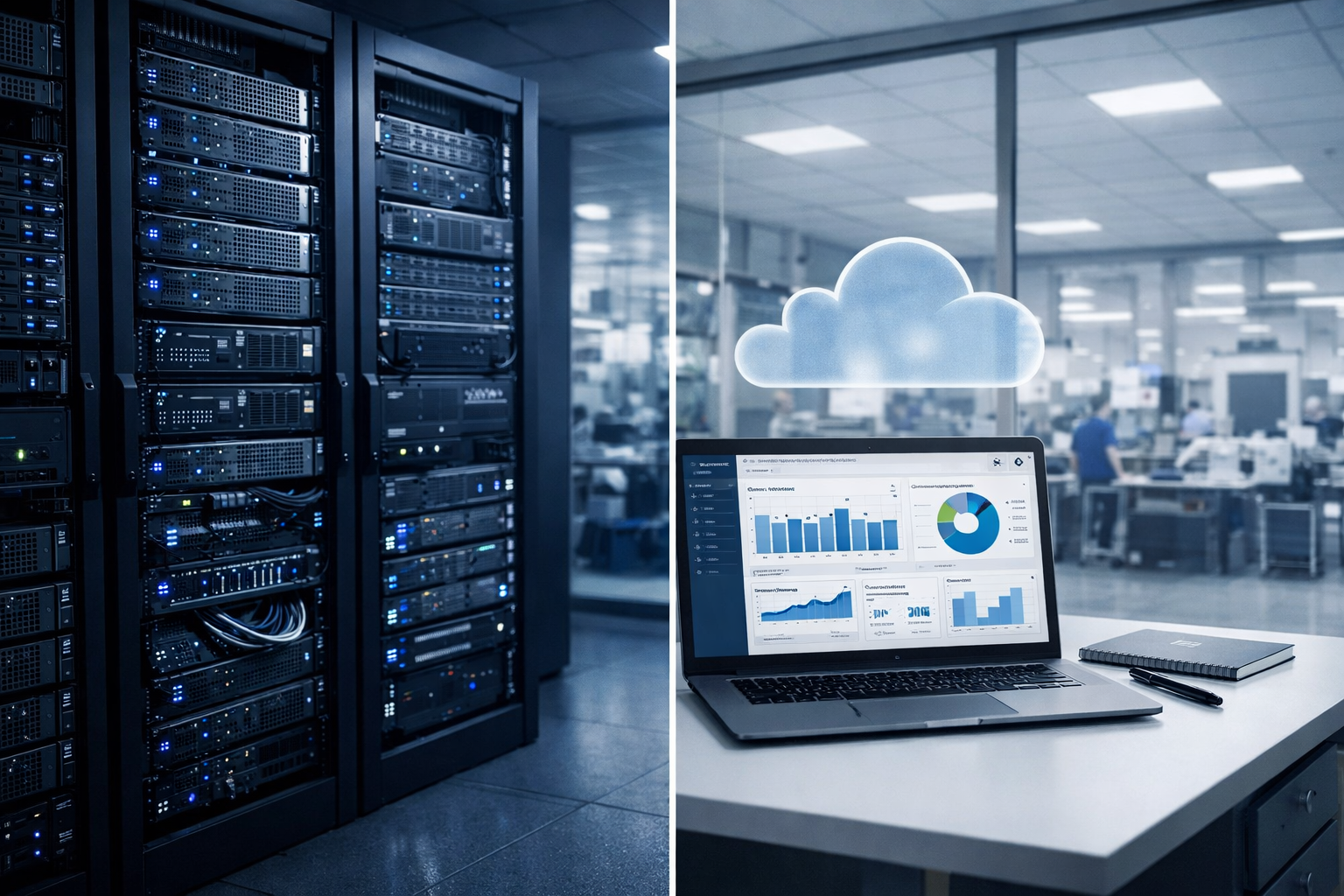
Before comparing the two models, it helps to understand what each means in a manufacturing context. On-premise ERP runs on servers you own, housed in your own building or a co-location facility. Your IT team (or MSP) manages the hardware, operating system, security patches, backups, and disaster recovery. You pay upfront licence fees plus annual maintenance and support charges. The system is physically close to your production network, which can be an advantage when integrating with shop floor systems like SCADA, MES, and PLCs.
Cloud ERP runs on the vendor’s infrastructure — typically in a major cloud data centre such as AWS, Azure, or Google Cloud. You pay a monthly or annual subscription per user. The vendor handles all infrastructure management, security patching, backups, and disaster recovery. Updates are delivered automatically, often monthly. Access is via a web browser from any location, which supports remote working and multi-site operations.
A third option — hybrid ERP — keeps certain modules on-premise (typically production-critical functions closely tied to OT systems) while moving others to the cloud (finance, HR, procurement, reporting). According to the Forterro survey, 33% of UK mid-market manufacturers already use a hybrid model, recognising that manufacturing often demands a more nuanced approach than pure cloud or pure on-premise.
The Case for Cloud ERP in Manufacturing in 2026
Cloud ERP offers compelling advantages for manufacturers, particularly those in growth mode or with limited IT resources:
- Lower upfront investment: Cloud ERP eliminates the capital expenditure on servers, networking, and data centre infrastructure. Subscription pricing converts a large upfront cost into predictable monthly operating expenditure — easier to budget and easier to justify to the board.
- Faster deployment: Cloud ERP implementations typically complete in three to nine months, compared to 12 to 18 months for on-premise. For manufacturers under time pressure — because an existing system is end-of-life or a customer is demanding new capabilities — this speed advantage matters.
- Automatic updates and security: The vendor delivers patches, security updates, and feature releases automatically. Your team does not need to plan, test, and deploy upgrades — a significant reduction in ongoing IT overhead.
- Scalability across sites: Adding a new production site, warehouse, or office simply means adding users to the subscription. There is no hardware to procure, install, or connect to the corporate network.
- Built-in disaster recovery: Cloud vendors provide geo-redundant infrastructure with automated failover. The average UK manufacturer expects to lose 41,888 pounds per day of ERP downtime, according to Forterro’s research. Cloud ERP’s built-in resilience directly addresses this risk.
- AI and analytics readiness: Cloud platforms are where ERP vendors are investing most heavily in AI, predictive analytics, and IoT integration. Manufacturers wanting access to predictive maintenance, demand forecasting, and intelligent scheduling will find these capabilities arriving first — and often exclusively — in cloud editions.
The Case for On-Premise ERP in Manufacturing in 2026
On-premise ERP remains the right choice in specific manufacturing scenarios that cloud cannot yet serve as well:
- Deep customisation requirements: Some manufacturers have highly specialised production processes that require extensive ERP customisation — custom modules, proprietary workflows, and bespoke integrations. Cloud ERP favours configuration over customisation, which can be limiting for complex manufacturing environments.
- OT integration and latency: Manufacturers running tight real-time integration between ERP and shop floor systems — PLCs, SCADA, MES — sometimes need the low latency that only a local server can provide. If your production scheduling relies on millisecond-level data exchange with industrial controllers, cloud latency may not be acceptable.
- Data sovereignty and regulatory compliance: Defence manufacturers, certain government suppliers, and businesses handling highly sensitive IP may require data to remain on premises within the UK, under their direct physical control. While cloud providers offer UK-based data centres, some regulatory frameworks and customer contracts explicitly require on-premise hosting.
- Total cost of ownership over long periods: For manufacturers who plan to run their ERP for 10 to 15 years with minimal change, the subscription costs of cloud ERP can exceed the total cost of an on-premise deployment over that period. However, this calculation must include the cost of internal infrastructure management, security, and the risk of running unsupported systems.
The Hybrid Approach: Why It Works for Many Manufacturers
The cloud ERP vs on-premise manufacturing UK 2026 decision does not have to be binary. The hybrid model is gaining traction because it allows manufacturers to match deployment to function. Production management, SCADA integration, and MES connectivity might remain on-premise where low latency and deep customisation matter most. Finance, procurement, HR, CRM, and business intelligence move to the cloud where accessibility, automatic updates, and scalability deliver more value.
This phased approach also manages risk. Rather than migrating an entire manufacturing ERP in one project — with all the disruption and risk that entails — you can move modules incrementally, proving the cloud model with lower-risk functions before committing production-critical systems. For manufacturers on legacy on-premise ERP systems approaching end of support, hybrid can provide a pragmatic transition path that avoids both the risk of a full migration and the risk of staying on an unsupported platform.
According to One Advanced’s 2026 ERP analysis, more than 100 UK CFOs in the past year have pivoted away from traditional global ERP giants in favour of platforms specifically tuned to the UK regulatory and economic landscape — often favouring composable, modular architectures that support exactly this kind of hybrid deployment.
How to Decide: A Framework for Manufacturers
Use this decision framework to navigate the cloud ERP vs on-premise manufacturing UK 2026 choice for your business:
Choose cloud ERP if: You have limited internal IT capability. You are growing and need to add sites or users quickly. Your current system is approaching end of support and you need to move within 12 months. You want access to AI and advanced analytics. Your production processes can work with standard ERP configurations rather than deep customisation. Your budget favours operating expenditure over capital expenditure.
Choose on-premise ERP if: You have highly customised manufacturing processes that require bespoke ERP modules. You need tight, low-latency integration with shop floor OT systems. Regulatory or customer requirements mandate on-premise data hosting. You have a strong internal IT team capable of managing infrastructure, security, and upgrades. Your ERP has a remaining useful life of 10+ years and a full migration is not justified.
Choose hybrid if: You want to modernise incrementally without a high-risk full migration. Some functions benefit from cloud (finance, analytics, remote access) while production-critical functions need to stay local. You are transitioning from legacy on-premise to cloud and need a phased approach. You operate multiple sites with different requirements.
Whichever model you choose, the decision should be led by someone who understands both the technology options and your manufacturing operation — not by the ERP vendor whose commercial interest is to push you toward their preferred deployment model.
Frequently Asked Questions
Is cloud ERP secure enough for manufacturers?
Yes, for most manufacturing businesses. Major cloud ERP vendors invest significantly more in cybersecurity than most individual manufacturers can afford internally — including encryption, multi-factor authentication, 24/7 monitoring, and compliance certifications such as SOC 2 Type II and ISO 27001. The Forterro survey found that 44% of UK manufacturers cited improved data security as a key benefit of cloud ERP. The exception is defence and classified manufacturing, where specific data sovereignty requirements may mandate on-premise hosting.
How much does it cost to migrate from on-premise to cloud ERP?
Migration costs vary significantly depending on the complexity of your existing system. For a mid-market manufacturer, a cloud ERP migration typically costs between 150,000 and 750,000 pounds including software, implementation, data migration, integration, and training. Research suggests that over 60% of cloud migration projects exceed their initial cost estimates, usually due to underestimated data migration complexity and integration requirements. Independent oversight during the selection and migration process significantly reduces the risk of cost overruns.
Will cloud ERP work with our shop floor systems?
Most modern cloud ERP platforms offer integration capabilities with MES, SCADA, and IoT systems through APIs and middleware. However, the quality and latency of these integrations varies significantly between vendors. If your manufacturing processes require real-time, millisecond-level data exchange with industrial control systems, test the specific integration thoroughly before committing. A hybrid approach — keeping production-critical integrations on-premise while moving business functions to the cloud — is often the most practical solution.
Should we wait for our ERP vendor to force the migration?
No. Waiting until your current on-premise ERP reaches end of support puts you in a reactive position with limited options and compressed timelines. Major vendors like SAP and Oracle are strategically shifting support away from on-premise solutions toward cloud. Starting the evaluation now — while your current system is still supported — gives you time to choose the right platform, plan the migration properly, and negotiate better terms. Rushed migrations driven by end-of-support deadlines consistently produce worse outcomes than planned transitions.
Take the Next Step
Bailey & Associates provides vendor-neutral ERP strategy and selection guidance specifically for UK manufacturers. Whether you are evaluating cloud, on-premise, or hybrid deployment, we help you make the decision based on your production needs, growth plans, and budget — not on what a software vendor is selling. Fixed monthly pricing from 2,000 pounds per month, no long-term tie-ins, and over 15 years of manufacturing IT experience. Book a free discovery call today.
Related Service: ERP & Digital Transformation Strategy — Learn how Bailey Associates can help your manufacturing business.
