
The fractional CIO vs IT consultancy manufacturing question comes down to whether you need ongoing strategic leadership or a one-off project deliverable. An IT consultant hands you a report and moves on. A fractional CIO becomes a member of your leadership team, owns your technology strategy, manages your vendors, and stays accountable for outcomes month after month. For UK manufacturers navigating ERP migrations, cybersecurity requirements, OT/IT convergence, and digital transformation, the retained leadership model consistently delivers more than episodic consulting — because the real challenge is not knowing what to do, but making it happen.
Last updated: 10 April 2026
Understanding the Fractional CIO vs IT Consultancy Difference in Manufacturing
Both models provide external IT expertise, but the nature of the engagement is fundamentally different. Understanding this distinction helps you choose the right approach for your manufacturing business.
An IT consultancy engagement is typically project-based. You commission a specific piece of work — a cybersecurity audit, an ERP selection assessment, a network design, or a technology strategy review. The consultancy delivers a report or recommendation, invoices for the work, and the engagement ends. You are left with good advice, but you are on your own when it comes to implementing it. For manufacturers, this creates a familiar pattern: the report sits on a shelf because nobody has the time, authority, or expertise to turn recommendations into action while production demands attention every day.
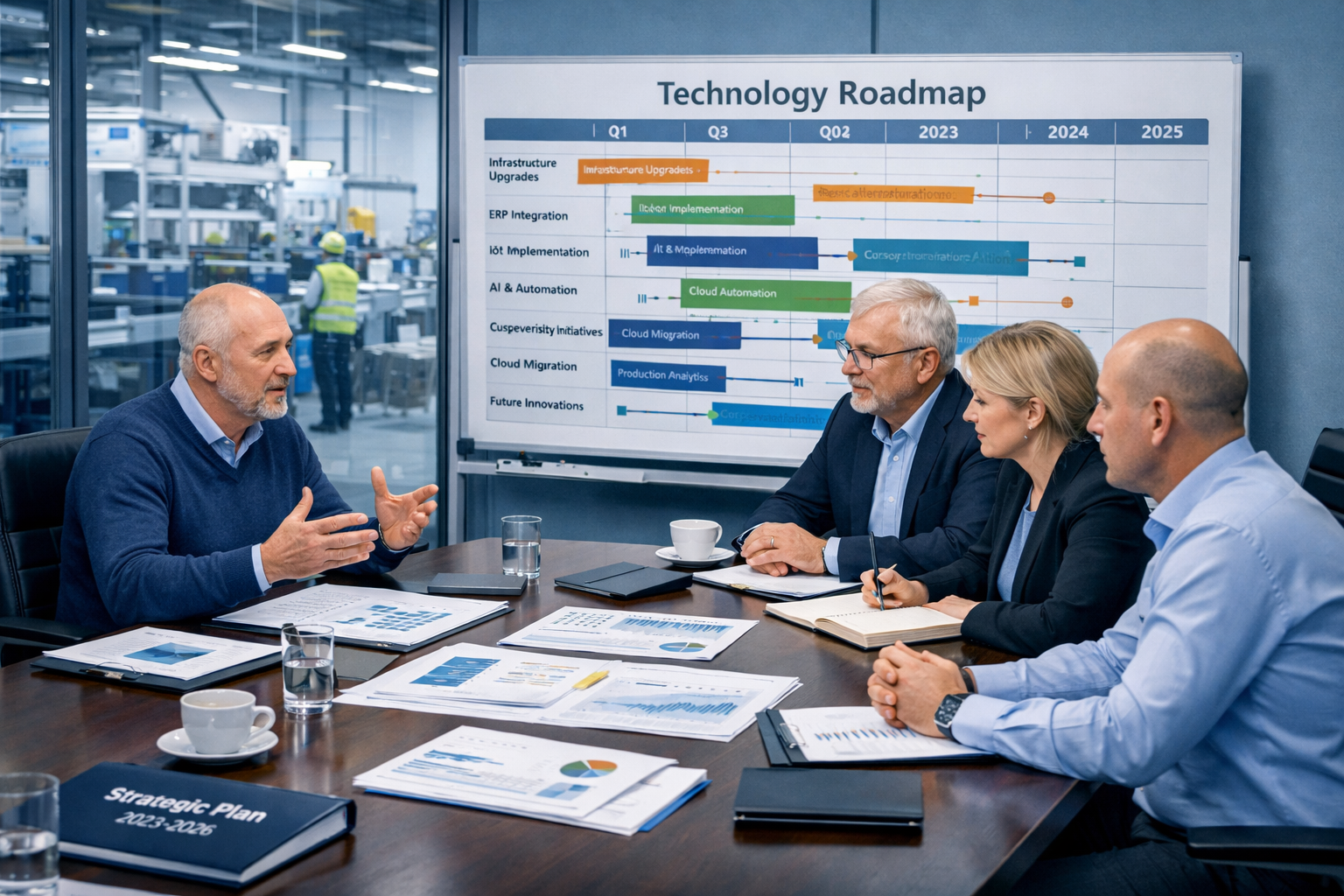
A fractional CIO engagement is retained. They work with your business on an ongoing basis — typically 8 to 24 hours per month — attending board meetings, managing vendor relationships, overseeing IT projects, and shaping your technology roadmap. They are accountable for outcomes, not just recommendations. When an ERP vendor misses a deadline, they hold the vendor to account. When a cybersecurity gap is identified, they ensure it gets closed. When the board needs to understand why a technology investment is justified, they present the business case in language the directors understand.
The fractional CIO vs IT consultancy manufacturing question is not about which is better in absolute terms — it is about which matches your current need. Short-term, well-defined projects suit consultancy. Ongoing strategic IT leadership suits the fractional model.
Why Traditional IT Consultancy Often Falls Short for Manufacturers
The standard consultancy model has specific limitations when applied to manufacturing environments:
- The implementation gap: Consulting reports are only valuable if they get implemented. Most mid-market manufacturers do not have an internal IT leader capable of translating a consultant’s recommendations into a managed programme of work. The report becomes another good intention that loses momentum within weeks of delivery.
- Lack of manufacturing context: Many IT consultancies serve multiple sectors. Their manufacturing knowledge may be theoretical rather than practical. They may not understand that an ERP cutover cannot happen during a model year launch, that OT networks have different security constraints than corporate IT, or that production uptime requirements mean changes must be planned around maintenance windows.
- No ongoing accountability: Once the consultant delivers their report, they have no stake in whether it succeeds. If vendor negotiations stall, if implementation timelines slip, or if the board decides not to fund the recommendations, nobody is there to push back or adapt the plan.
- Recurring cost without retained value: Manufacturers who rely on consultancy often find themselves re-engaging the same firm repeatedly for related work — paying each time for the consultant to re-learn the environment. Over 12 months, episodic consultancy frequently costs more than a retained fractional CIO engagement while delivering less continuity.
- Vendor conflicts: Some IT consultancies have commercial relationships with technology vendors, which can influence their recommendations. A fractional CIO with no vendor affiliations provides genuinely independent advice.
What a Fractional CIO Delivers That a Consultancy Cannot
The retained, ongoing nature of a fractional CIO engagement enables capabilities that project-based consulting simply cannot replicate:
Strategic ownership and accountability. A fractional CIO owns your IT strategy. They do not just advise — they take responsibility for ensuring the strategy is executed. This is particularly valuable during complex, multi-month programmes like ERP implementations, OT security improvements, or factory automation projects where continuous leadership is essential.
Deep knowledge of your manufacturing operation. Over months and years, a fractional CIO develops intimate knowledge of your production environment, your people, your vendor landscape, and your business priorities. This contextual understanding means their advice improves over time — the opposite of a consultant who starts from scratch on each engagement.
Board-level presence and credibility. A fractional CIO attends board meetings, presents technology investment cases, and translates complex IT matters into business language. This bridges the gap between the shop floor and the boardroom that exists in most manufacturers without dedicated IT leadership.
Vendor management and negotiation. Holding MSPs, ERP vendors, and other technology suppliers to account requires ongoing relationships and market knowledge. A fractional CIO benchmarks your contracts, negotiates renewals, and ensures service levels are met — work that generates savings often exceeding their own engagement cost.
The Make UK Executive Survey 2026 found that 60% of manufacturers cite skills as the major barrier to adopting AI and automation. This skills gap extends beyond technical capability — it includes the strategic IT leadership needed to evaluate, plan, and oversee technology investments. A fractional CIO fills exactly this gap.
When IT Consultancy Is the Right Choice for Manufacturers
Consultancy remains valuable for specific, bounded engagements. Use an IT consultancy when:
- You need a one-off specialist assessment: A penetration test, a specific compliance audit, or an independent evaluation of a vendor proposal — these are well-defined deliverables where a specialist consultant adds clear value.
- You have internal IT leadership already: If you already have a capable CIO or IT director who needs specialist support for a specific project, consultancy augments their capability without duplicating the leadership role.
- The scope is genuinely bounded: A three-month network redesign, a software selection exercise, or a data migration plan — if the deliverable is clear, the timeline is short, and you have someone internally to manage implementation, consultancy works well.
The issue arises when manufacturers use consultancy as a substitute for the ongoing strategic IT leadership they actually need. If you find yourself engaging consultants repeatedly for related work, or if consultant reports are not being implemented, the retained model is likely a better fit.
The Growing UK Market for Fractional IT Leadership
The fractional CIO model has expanded rapidly across the UK, driven by the same skills shortages and cost pressures that make it impractical for most mid-market manufacturers to hire a full-time technology executive. According to LinkedIn data, profiles carrying the fractional executive title grew from around 2,000 in 2022 to over 110,000 by early 2024 — reflecting a structural shift in how businesses access senior leadership. Providers such as Leadership Services, which offers part-time IT directors from 1,795 pounds per month, demonstrate the breadth of options available to businesses seeking flexible IT leadership without the commitment of a permanent hire. For manufacturers specifically, the key differentiator when choosing a fractional CIO vs IT consultancy manufacturing firms should prioritise is sector expertise — ensuring whoever leads your IT strategy understands ERP, OT networks, production constraints, and the regulatory landscape unique to manufacturing.
The Make UK Skills Investment Pledge highlights that skills shortages remain one of the biggest barriers to growth and productivity for manufacturers, with around 50,000 live vacancies across the sector. In this environment, fractional IT leadership is not a compromise — it is a practical response to a structural reality.
How to Choose Between a Fractional CIO and an IT Consultancy
Use this decision framework to determine which model suits your manufacturing business:
Choose a fractional CIO if: You have no dedicated IT leadership. Technology decisions are being made by the MD, the office manager, or the MSP. You are facing a major technology investment (ERP, automation, cybersecurity overhaul) that will take 6 to 18 months. Your board cannot articulate the IT strategy. Vendor contracts are auto-renewing without review. You need someone accountable for making things happen, not just telling you what to do.
Choose an IT consultancy if: You have a specific, bounded project that needs specialist expertise. You already have internal IT leadership and need to augment their capability. The engagement has a clear deliverable, timeline, and end point. You need an independent second opinion on a vendor recommendation or technology proposal.
Consider both: Many manufacturers use a fractional CIO as their retained IT leader and engage specialist consultants for specific technical work under the fractional CIO’s oversight. The fractional CIO defines the scope, selects the consultant, and ensures the deliverables get implemented — combining strategic continuity with specialist depth.
Frequently Asked Questions
What is the main difference between a fractional CIO and an IT consultant?
A fractional CIO is a retained, ongoing member of your leadership team who takes strategic ownership of your IT function. An IT consultant is engaged for a specific project or assessment, delivers a report or recommendation, and the engagement ends. The fractional CIO is accountable for implementation and outcomes over time; the consultant is accountable for the quality of their advice on a specific topic.
Is a fractional CIO more expensive than hiring an IT consultancy?
On a monthly basis, a fractional CIO typically costs between 2,000 and 8,500 pounds per month depending on hours and complexity. A consultancy engagement might cost 5,000 to 30,000 pounds per project. Over 12 months, manufacturers who rely on episodic consultancy often spend more than they would on a retained fractional CIO, while receiving less continuity and implementation support. The fractional model also tends to generate savings through vendor negotiation and waste elimination that offset the engagement cost.
Can a fractional CIO manage IT consultants on my behalf?
Yes, and this is one of the most valuable aspects of the model. A fractional CIO defines the brief, selects the right consultant, manages the engagement, and ensures the deliverables are implemented. Without this oversight, consultant reports often fail to translate into action because nobody internally has the authority or expertise to drive implementation.
How quickly can a fractional CIO make an impact in a manufacturing business?
Most fractional CIOs complete an initial IT assessment within four to six weeks, identifying quick wins and strategic priorities. Tangible results — vendor savings, improved cybersecurity posture, a clear technology roadmap — typically emerge within the first three months. The value compounds over time as the fractional CIO’s understanding of your manufacturing operation deepens and the strategic relationship with your board matures.
Take the Next Step
Bailey & Associates provides fractional CIO and IT director services built specifically for UK manufacturers. Unlike project-based consultancy, our retained model means we are accountable for outcomes — not just recommendations. With fixed monthly pricing from 2,000 pounds per month, no long-term tie-ins, and over 15 years of manufacturing IT experience, we provide the strategic IT leadership your business needs to plan, execute, and deliver technology change that supports production and growth. Book a free discovery call today.
Related Service: Fractional CIO/IT Director — Learn how Bailey Associates can help your manufacturing business.
